

Parents: Cut Retainer Speech Issues to 3–14 Days With Thin Retainers
Yes, retainers commonly cause temporary speech changes, and most people adapt within a few days to a few weeks. Sibilant sounds like /s/ and /z/, along with some fricatives, take the biggest hit at first. Hawley retainers tend to need more adjustment time than thin, clear vacuum-formed ones. If distortion lingers well past the expected window or comes with pain, that’s your cue to call your orthodontist or a speech-language pathologist.
TL;DR:
- Hawley retainers with bulkier acrylic and wire components tend to cause more prolonged speech distortion, especially on /s/ and /z/ sounds, than thinner vacuum-formed retainers.
- Most speech issues improve significantly within three to 14 days, but bulky appliances may require up to three months for full normalization.
- Smaller, well-fitting clear retainers with less palate coverage reduce both the severity and duration of speech disturbances.
- Persistent speech problems beyond the typical adjustment window or accompanied by pain should prompt a consultation with an orthodontist or speech-language pathologist.
- Practicing sibilant drills, reading aloud daily, and ensuring a precise, minimally bulky retainer fit can significantly speed up speech recovery.
Table of Contents
- Retainer Speech Issues: Which Sounds Change and How to Spot Them
- Why Retainers Change Speech in the First Place
- How Retainer Type Changes the Speech Impact
- The Adjustment Timeline: What Normal Recovery Looks Like
- Exercises and Habits That Speed Up Speech Recovery
- When to Contact Your Orthodontist or a Speech-Language Pathologist
- Morning Retainer Speech vs. Speech After Hours of Wear
- Speech and Permanent or Fixed Retainers Long-Term
- Retainers vs. Braces, Aligners, and Other Appliances
- The Social Side of Retainer Speech Changes
- Our Take: Thinner Retainers, Shorter Adjustment
- Get a Thinner Retainer That Fits Right From the Start
- Sources
- FAQ
Retainer Speech Issues: Which Sounds Change and How to Spot Them
Not every sound gets scrambled the same way. Sibilants, the /s/ and /z/ sounds, are the most frequent casualties because they depend on a tight, precise gap between your tongue and the roof of your mouth. Add a strip of acrylic or plastic there, and the airflow that creates those crisp hissing sounds gets rerouted.
The usual suspects:
- /s/ and /z/ (as in “see” or “zoo”) — often come out with a whistle or a lisp
- /θ/ and /∫/ (“think,” “she”) — can sound muffled or slushy
- Certain vowels, especially /i:/ (“see,” “beat”) — resonance shifts and the vowel sounds flatter
- Some consonants in Hawley wearers, due to the wire and acrylic sitting near the front teeth
A quick home test: read “See Susie sell seashells by the seashore” out loud. If you hear air leaking around your front teeth or a faint whistle on the /s/, that’s classic retainer lisp. A muffled quality on vowels usually means the appliance is changing how sound bounces around your mouth, not a sign anything is wrong with the fit.
Why Retainers Change Speech in the First Place
Your tongue needs a specific amount of open space to hit certain sounds cleanly. A retainer, especially one with palatal acrylic, takes up some of that space and shifts where your tongue naturally rests. That’s the root of most retainer speech issues, and it explains why the same appliance can affect two people differently depending on their natural bite and palate shape.
Coverage over the biting surfaces of your teeth also changes your vertical dimension, which is the technical term for how far apart your jaws sit when your teeth touch. Shift that even slightly, and the contact points your tongue relies on for consonants move too. Airflow gets redirected, resonance shifts, and vowels can sound thinner or more nasal.
Thickness and shape matter more than people expect. A retainer that’s a fraction of a millimeter thicker, or one with more bulk near the front teeth, can add real adjustment time. Small tweaks to anterior contouring during a fitting can shave days off recovery.
How Retainer Type Changes the Speech Impact
Design drives outcome here more than almost anything else. Acoustic analysis comparing Hawley retainers to vacuum-formed clear retainers found the Hawley group had more pronounced, longer-lasting distortion, particularly on /s/ and certain vowels, while the vacuum-formed group largely normalized within a month.
- Hawley and full-palate acrylic retainers: bulkier, with wire and acrylic near the front teeth, so /s/, /z/, and some vowels distort more and take longer to smooth out.
- Vacuum-formed and clear thermoplastic retainers: thin and closely conforming to your teeth, which usually means milder, shorter-lived speech effects.
- Thermoplastic designs with heavier occlusal coverage: can shift vertical dimension and interfere with labiodental sounds like /f/ and /v/. A crossover trial testing four removable retainer designs found that thermoplastic and certain wraparound styles caused significant speech changes at insertion, and three weeks wasn’t always long enough for full recovery.
If you’re comparing options with your orthodontist, ask specifically how palatal coverage and thickness on the appliance they’re recommending compare to a thin clear retainer. That one question tells you a lot about what your first few weeks will sound like.
The Adjustment Timeline: What Normal Recovery Looks Like
Most speech problems from a new retainer follow a predictable arc, though the calendar shifts depending on the appliance.
- Day 1 to 2: Distortion is at its worst. Sibilants whistle, some vowels sound off, and talking feels effortful. This is expected, not a sign of a bad fit.
- Day 3 to 7: Noticeable improvement for most wearers, especially with clear or vacuum-formed retainers. Sentences start feeling more automatic.
- Week 3 to 4: Clear retainer wearers are usually close to normal speech. Most patients adapt within 3 to 14 days, based on clinical research on adaptation windows.
- Month 2 to 3: Hawley wearers may still be fine-tuning, particularly on /s/ and /z/. Some documented cases show distortion persisting up to three months for bulkier designs.
If you’re a month into wearing a clear retainer and still whistling on every /s/, or three months into a Hawley with zero improvement, that’s not “still adjusting.” That’s a sign to get the fit checked.
Exercises and Habits That Speed Up Speech Recovery
Adjustment isn’t purely passive. Practice actually shortens the timeline, and it costs nothing but a few minutes a day.
- Slow sibilant drills: Repeat words like “sun,” “zoo,” and “seesaw” slowly, focusing on tongue placement, then gradually speed up.
- Exaggerated /θ/ and /f/ practice: Overemphasize “think,” “three,” and “five” in front of a mirror to retrain lip and tongue coordination.
- Read aloud daily: Five to ten minutes of reading out loud, every day, retrains your brain’s speech patterns faster than casual conversation alone.
- Record yourself: Playing back a short recording after a few days shows progress you might not notice in the moment.
- Give your mouth a break from saliva buildup: Rinsing or brushing before speech practice reduces the slushy quality some new wearers notice.
- Don’t skip wear time to “fix” the lisp: Removing the retainer more than prescribed only resets the adaptation clock. Consistency is what trains your tongue.
Pro Tip: Do your practice reading out loud alone first, not at the dinner table or in a work meeting. Get comfortable with the sibilant drills in private for a few days before testing your speech in front of other people. It takes the pressure off and speeds up real progress.
When to Contact Your Orthodontist or a Speech-Language Pathologist
Most speech changes resolve on their own, but a few signs mean it’s time to get help rather than wait it out.
Call your orthodontist if there’s no improvement after the expected window (about a month for clear retainers, 6 to 12 weeks for bulkier designs), if you notice sores, sharp edges, or pain, or if the appliance feels loose or cracked. These are fit problems, and an orthodontist can adjust or remake the retainer to solve them directly.
A speech-language pathologist becomes the right call when the retainer fits correctly, your orthodontist confirms there’s no mechanical issue, but articulation still hasn’t normalized. Targeted therapy can retrain tongue placement faster than waiting it out, especially for kids who’ve developed a compensatory lisp that’s stuck around past the expected adjustment period.
Morning Retainer Speech vs. Speech After Hours of Wear
Speech distortion isn’t constant throughout the day. It shifts noticeably depending on how long the retainer has been in and how recently you inserted it.
Right after insertion, especially first thing in the morning or right after a meal when you pop the retainer back in, distortion tends to be sharpest. Your tongue hasn’t re-registered where the appliance sits, saliva flow adjusts, and sibilants come out slushier than they will an hour later. This is completely normal and usually fades within minutes to an hour as your tongue recalibrates.
After extended wear, speech generally smooths out considerably. Many wearers report their speech sounds close to normal by midafternoon on a day they’ve had the retainer in since morning, only to notice the same mild distortion return the next morning after a night in the retainer case. That reset pattern is common in the early weeks and tends to shrink as full adaptation kicks in, usually somewhere in the 3 to 14 day window most patients experience.
Nighttime-only wearers (common with retention retainers after active treatment) often notice a brief “reset” of mild distortion each morning after removing the appliance overnight, then no issues for the rest of the day since they’re not wearing it during waking hours. Full-time wearers face a longer curve but usually end up with more consistent, all-day clarity once adaptation completes, since their mouths never get a break from the new baseline.
Speech and Permanent or Fixed Retainers Long-Term
Fixed retainers, the thin wires bonded behind your front teeth, work differently than removable ones, and their speech impact usually plays out differently too. Because they sit close to the tongue side of the teeth without covering the palate, most wearers don’t experience the same sibilant distortion that removable Hawley or acrylic retainers cause.
That said, fixed retainers aren’t entirely speech-neutral. A wire with excess bonding material, or one placed slightly bulkier than necessary, can create a subtle lisp that some patients notice years into wearing it, particularly if the wire shifts or partially debonds on one end. Because a fixed retainer stays in permanently, any speech interference tends to be lower-grade but longer-lasting compared to the sharper, faster-fading distortion from a removable appliance.
The practical long-term takeaway: if you have a fixed retainer and develop a new lisp or whistle months or years after it was placed, that’s not “normal adjustment” the way it is with a new removable retainer. A wire that’s been in place for a year shouldn’t suddenly start affecting your speech. Treat a late-appearing speech change with a fixed retainer as a sign the wire has shifted, partially detached, or accumulated buildup, and get it checked rather than assuming it will self-correct the way early speech changes do with removable appliances.
Retainers vs. Braces, Aligners, and Other Appliances
Retainers aren’t the only orthodontic appliance that messes with speech, but they behave differently than the alternatives.
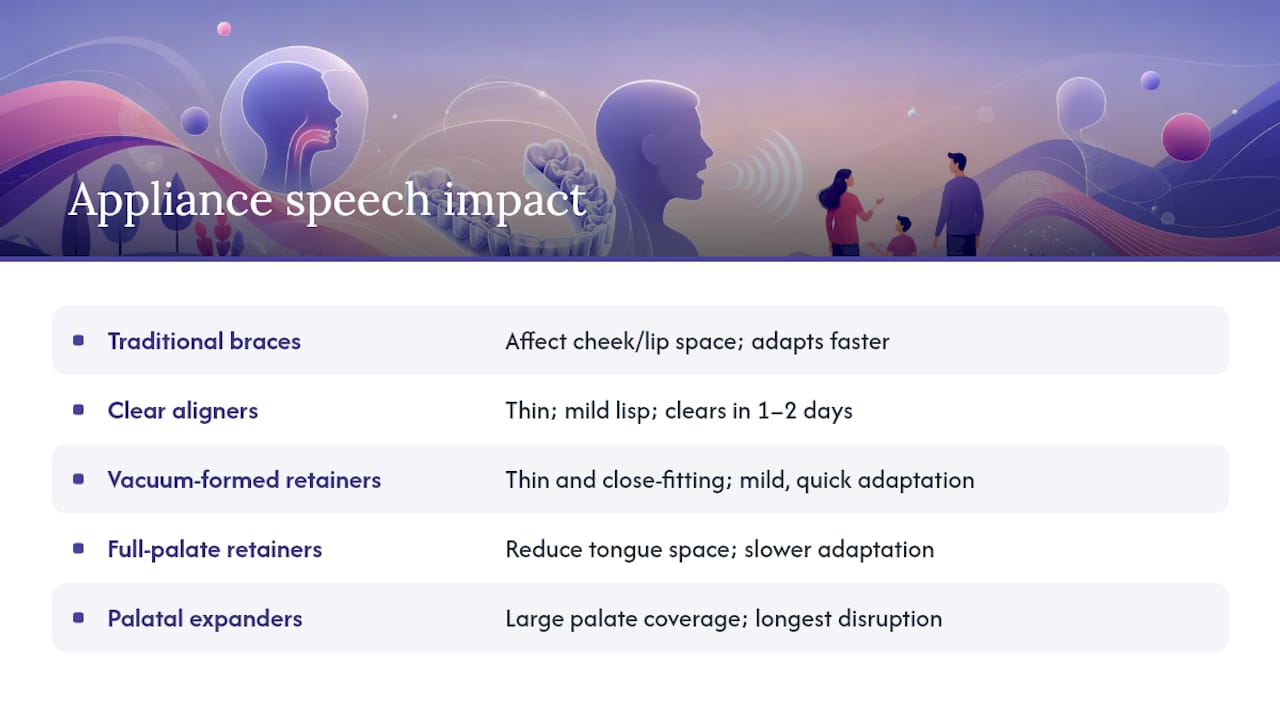
Traditional braces affect speech mainly through cheek and lip space, since brackets and wires sit on the front surface of the teeth rather than the palate. Most people adapt to braces-related speech changes faster than to a full-palate retainer, because braces don’t reduce tongue space the same way palatal acrylic does.
Clear aligners (the removable plastic trays used during active treatment) tend to cause milder speech effects than Hawley retainers for a similar reason to vacuum-formed retainers: they’re thin and closely fitted. Wearers sometimes notice a faint lisp in the first days of a new aligner tray, but it usually clears within a day or two, faster than typical retainer adaptation because aligners are replaced every one to two weeks and each new tray is nearly identical to the last.
Palatal expanders, used to widen a narrow upper jaw, tend to cause more significant and longer-lasting speech disruption than most retainers because they cover a large portion of the palate with a rigid structure the tongue can’t easily work around. Kids with expanders often develop a more noticeable lisp than kids with clear retainers, and it can take longer to fade.
The pattern across all of these appliances is consistent: the more palate coverage and bulk an appliance has, the more it disrupts speech, and the longer full adaptation takes.
The Social Side of Retainer Speech Changes
A lisp or whistle doesn’t just affect how you sound. For a kid returning to school with a new retainer, or an adult heading into client meetings, the self-consciousness can matter as much as the mechanics of the sound itself.
Kids are often more resilient about this than parents expect, especially when they know in advance that the change is temporary and common. Framing it as “your mouth is learning a new shape” rather than “something’s wrong” tends to reduce anxiety. Practicing at home first, away from an audience, gives kids (and adults) a private space to work through the awkward stage before testing it socially.
For teens and adults self-conscious about speaking in meetings, presentations, or on calls, a few practical coping moves help: slow down deliberately rather than rushing through sentences, choose words with fewer heavy sibilants when a big presentation lands during the first week of a new retainer, and remind yourself that most listeners either don’t notice or assume you have a slight cold. The distortion is far more obvious to the wearer than to anyone listening.
Our Take: Thinner Retainers, Shorter Adjustment
The orthodontic world still leans heavily on Hawley retainers out of habit, not because they’re gentler on speech. The evidence points the other way. Bulkier acrylic and wire designs consistently take longer to adapt to, and the discomfort that comes with that extended adjustment is a real reason patients stop wearing retainers as prescribed, which then undoes the entire point of retention in the first place.
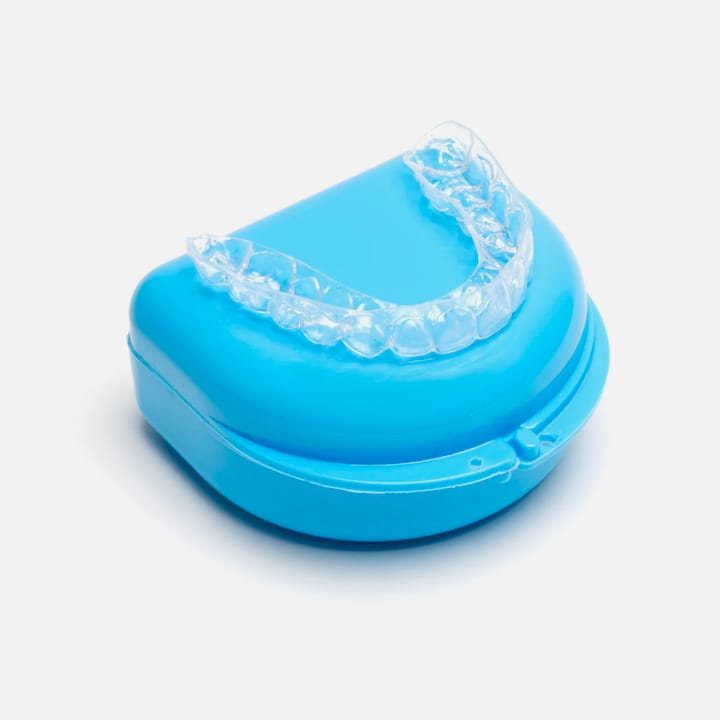
Some companies build retainers thin and vacuum-formed, closely conforming to the teeth rather than covering the palate with bulk acrylic. Design choices that reduce palatal coverage and overall thickness are linked to less speech interference and better comfort, and that’s the entire logic behind a thin clear retainer versus a traditional Hawley. If your retainer routinely feels like it’s fighting your tongue weeks after you got it, the appliance design is worth questioning before you assume you’re just a slow adapter.
The self-impression model also matters more than people give it credit for. A retainer that fits precisely from day one has less room to trap your tongue in awkward positions, which is half the battle with early speech distortion. Explore the upper retainer options or the lower retainer designs if a current appliance is causing more disruption than it should.
— Clear
Get a Thinner Retainer That Fits Right From the Start
Custom clear retainers designed to conform closely to your teeth rather than bulk up your palate are linked to shorter speech adjustment and better comfort. These are often ordered online, using guided self-impression kits completed at home, avoiding office visit markups charged by traditional orthodontic practices, and made with FDA-approved materials under the supervision of experienced orthodontic technicians.
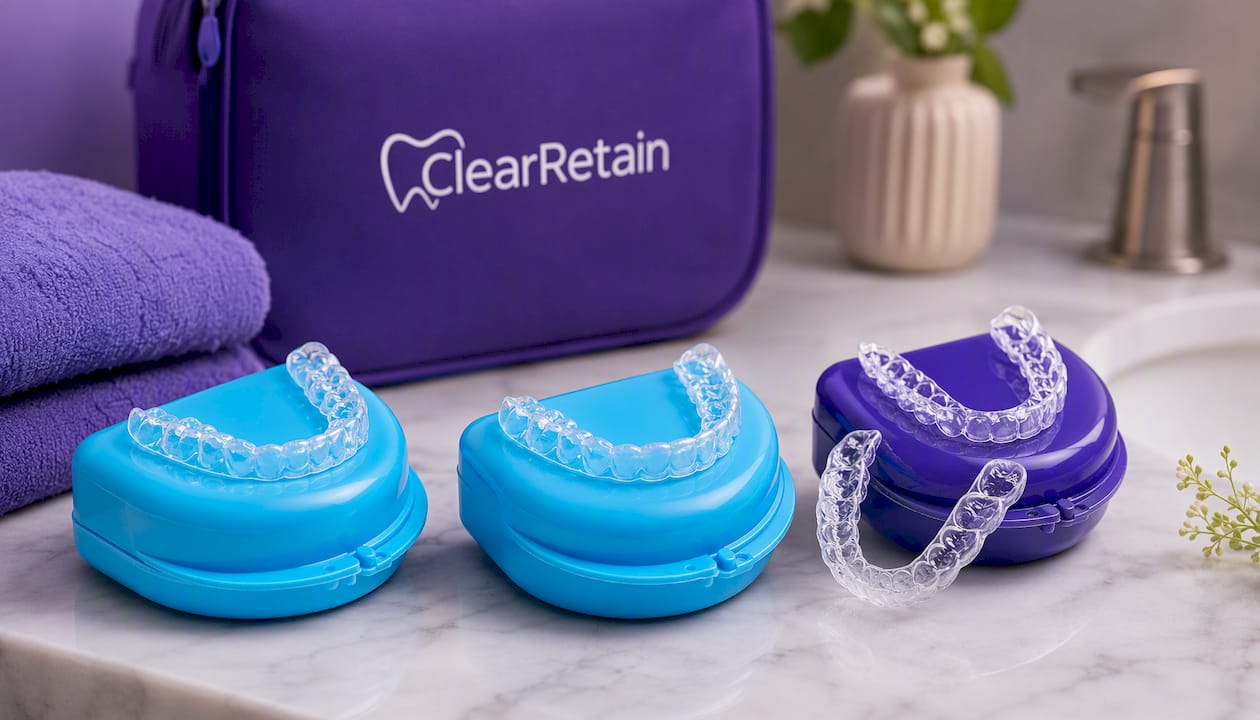
If you need a single arch, the upper teeth retainer and lower teeth retainer are both available on their own. Most people replacing worn or ill-fitting appliances, or covering both arches from the start, choose the upper and lower retainer set, and your stored digital impression makes reordering fast if you ever need a replacement. Start your self-impression kit today and get a retainer built to reduce the speech disruption a bulkier appliance would cause.
Sources
- Study reporting typical adaptation windows and occasional longer-lasting speech distortion
- Speech effects of Hawley and vacuum-formed retainers by acoustic analysis: A single-center randomized controlled trial
FAQ
Is it normal to have difficulty speaking with a retainer?
Yes, temporary speech distortion is one of the most common side effects of a new retainer, especially on sibilant sounds like /s/ and /z/. Most people adapt within 3 to 14 days, though bulkier designs like Hawley retainers can take longer.
Can a speech impediment be fixed?
Speech distortion caused by a retainer is usually temporary and resolves on its own as your tongue adapts to the appliance. If it doesn’t improve after the expected window, an orthodontist can check the fit, and a speech-language pathologist can provide targeted articulation therapy if the problem persists despite a correct fit.
Does retainer lisp go away?
For most wearers, yes. Clear and vacuum-formed retainers tend to normalize within about a month, while Hawley retainers can take longer, with some cases of lingering /s/ distortion reported up to three months. Practicing sibilant drills and reading aloud daily tends to speed the process along.
Can an underbite affect my speech?
An underbite can change tongue positioning and airflow independent of any retainer, which is part of why orthodontic correction is often recommended in the first place. When a retainer is added on top of an existing bite issue, speech adjustment can take slightly longer, since the tongue is adapting to both the bite correction and the new appliance at once.