

FDA-Approved Retainer Material Types: A Science-Backed Guide
The FDA-cleared retainer materials you’ll encounter fall into three families: PMMA-based acrylic (used in Hawley plates), thermoformed thermoplastics (PET-G, TPU, polypropylene, polycarbonate, and EVA used in clear Essix-style retainers), and stainless-steel or titanium wires used in bonded fixed retainers. Clearretain uses FDA-approved materials manufactured under orthodontic technician supervision and tested to ISO 10993 biocompatibility standards, which is the device-level benchmark that actually matters for patient safety.
Removable retainers are regulated as Class II medical devices in the U.S. and typically enter the market through 510(k) premarket notification. “FDA-approved” in everyday conversation usually means “FDA-cleared” at the device level, not just that the raw polymer passed a food-contact test. Manufacturing process and post-processing steps determine whether a finished retainer is genuinely biocompatible, regardless of what the base plastic is called.
TL;DR — what to act on:
- Ask any supplier for their 510(k) number, ISO 10993 test summaries (specifically ISO 10993-5 and ISO 10993-10), and material safety data sheets (MSDS/TDS).
- Prefer heat-cured PMMA or professionally thermoformed PET-G/TPU from a regulated lab over cold-cure or poorly documented alternatives.
- For 3D-printed retainers, confirm thorough washing and UV post-cure steps before wearing.
- Clearretain’s products are made under documented QA and orthodontic technician oversight.
Table of Contents
- What materials are used in each type of retainer?
- How FDA regulation and “medical-grade” actually apply to retainers
- BPA, plasticizers, residual monomers: what the evidence actually shows
- How do these materials compare on durability, aesthetics, and cost?
- Why manufacturing process matters as much as the material itself
- How long does each retainer material last, and how do you care for it?
- Choosing a retainer material based on your specific situation
- How Clearretain approaches materials, safety, and what to ask before you buy
- Key Takeaways
- The marketing label problem with retainer materials
- Clearretain’s retainers: documented materials, professional oversight, real savings
- Primary sources and further reading
What materials are used in each type of retainer?
The retainer type your orthodontist recommends determines the material you’ll be wearing. Each style draws from a distinct set of polymers or metals, and understanding that map helps you ask the right questions.
Hawley retainers (removable acrylic plate + wire)
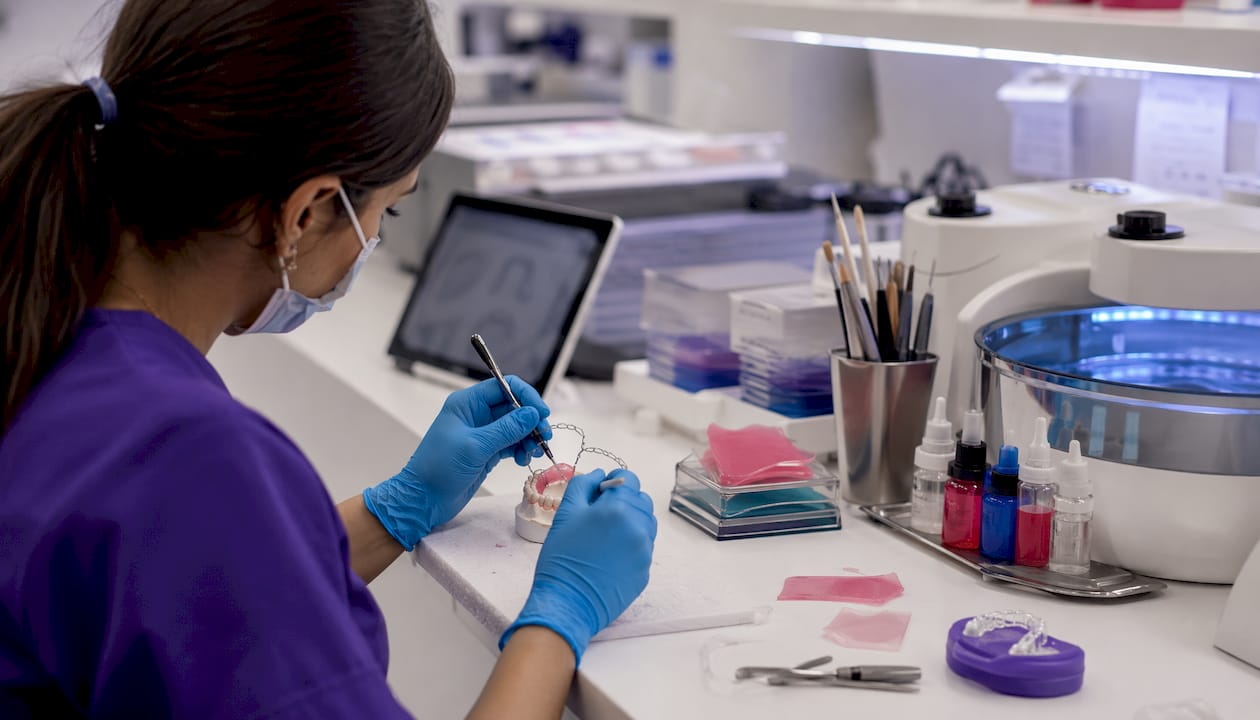
The plate is made from polymethyl methacrylate, better known as PMMA acrylic. Heat-cured PMMA achieves higher monomer conversion than cold-cure (auto-polymerizing) acrylic, which means less residual methyl methacrylate (MMA) remains in the finished plate. That matters because residual MMA is a known irritant and the most common explanation for early sensitivity with a new Hawley. The wire component is typically 304 or 316 stainless steel, sometimes titanium-molybdenum alloy for patients with nickel sensitivity.
Clear vacuum-formed retainers (Essix-style)
These are the thermoformed thermoplastics most people picture when they hear “clear retainer.” The main materials:
- PET-G (polyethylene terephthalate glycol-modified): Stiff, optically clear, widely used. Causes the least tissue irritation in clinical reports.
- TPU (thermoplastic polyurethane): More flexible and comfortable for initial wear; often preferred for patient comfort.
- Polypropylene (PP): Lightweight, chemically resistant, lower stiffness than PET-G.
- Polycarbonate (PC): High stiffness and impact resistance; useful for heavy-wear cases.
- EVA (ethylene-vinyl acetate): Softer, sometimes used in sports-adjacent or pediatric applications; also shows low irritation clinically.
Bonded/fixed retainers
No plastic at all. A multi-strand or solid wire, typically 316L stainless steel or a titanium alloy, is bonded directly to the lingual surface of the teeth with dental composite. These are the go-to when long-term stability is non-negotiable and patient compliance is a concern.
Emerging: 3D-printed photopolymer resins
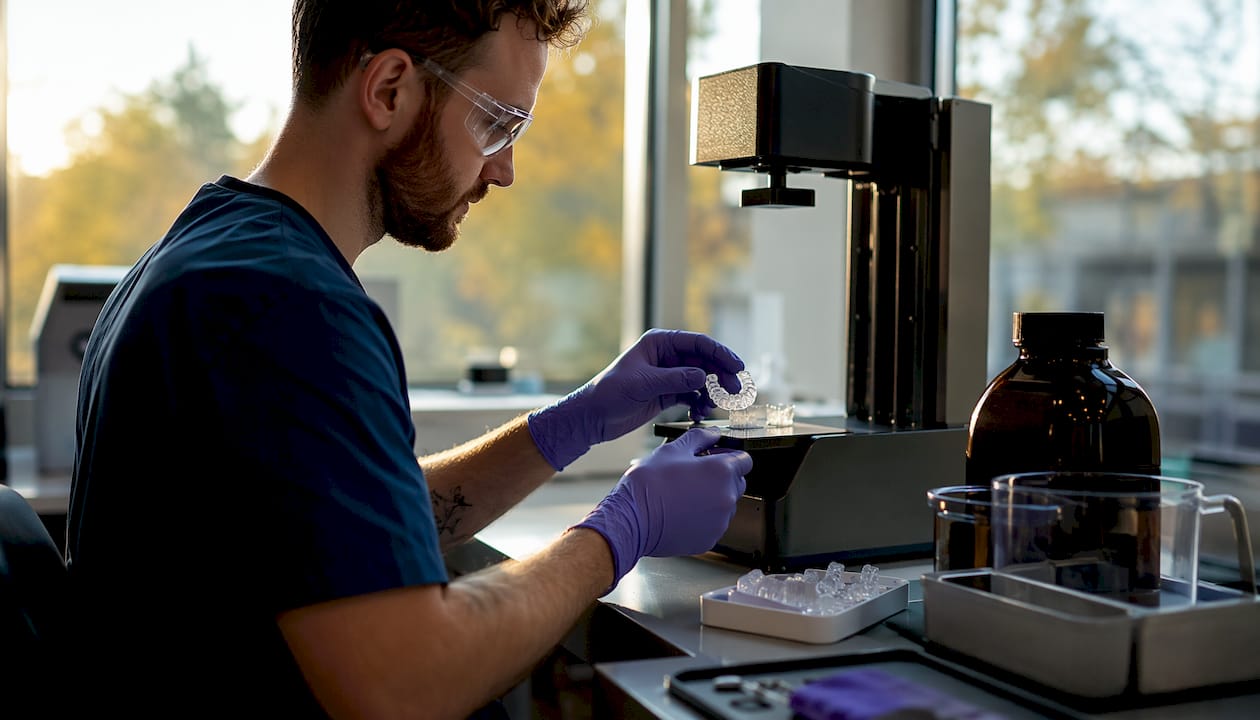
Directly printed light-curable resins are a growing alternative, shortening fabrication time and enabling custom geometries. The trade-off is process sensitivity: printed resins can leach unreacted methacrylate monomers and photoinitiator byproducts unless washing and UV post-cure steps are thorough. More on that in the manufacturing section.
How FDA regulation and “medical-grade” actually apply to retainers
“FDA-approved” gets used loosely in dental marketing, and the distinction between device-level clearance and raw-material labeling is one most buyers never think to ask about.
Device-level vs. raw-material regulation
A retainer is regulated as a finished medical device under 21 CFR Part 872 (dental devices). The relevant pathway for most removable retainers is 510(k) premarket notification, which requires the manufacturer to demonstrate substantial equivalence to a legally marketed predicate device. The raw polymer sheet a lab buys from a supplier may carry its own food-contact or USP Class VI designation, but that does not automatically make the finished retainer cleared. The device-level clearance is what counts.
What “medical-grade” means in practice
“Medical-grade” is not a single FDA designation. When a supplier uses the term, it typically signals that the material meets USP Class VI or ISO 10993 biocompatibility criteria. ISO 10993 is the accepted international standard suite for evaluating medical device biocompatibility. The two parts most relevant to retainers are ISO 10993-5 (cytotoxicity) and ISO 10993-10 (irritation and sensitization). A finished device that has passed these tests, under documented conditions, is meaningfully different from one where only the raw sheet carries a supplier’s “medical-grade” label.
Trust signals to request before buying
- 510(k) number or predicate device reference (searchable in the FDA’s 510(k) database)
- ISO 10993-5 and ISO 10993-10 test reports for the finished device
- MSDS or Technical Data Sheet for the specific polymer lot
- Lab/QA oversight documentation (who manufactured it and under what controls)
- Post-processing SOP summary (especially for printed resins)
Pro Tip: You don’t need a chemistry degree to verify a 510(k). Go to the FDA’s 510(k) database at accessdata.fda.gov, enter the number the supplier gives you, and confirm the device description matches what you’re buying. If a supplier can’t provide a 510(k) number or a clear explanation of why it’s exempt, that’s a meaningful data point.
For a broader look at how device regulatory pathways work, the medical device compliance guide from Labgistics covers the 510(k) process in accessible terms.
BPA, plasticizers, residual monomers: what the evidence actually shows
Chemical leaching concerns are legitimate, but the risk picture is more nuanced than most “BPA-free” marketing suggests.
Thermoformed thermoplastics
Systematic in vitro reviews covering 2015–2025 report that thermoformed materials (PET-G, TPU, PP, EVA) typically show cell viability ≥80% under ISO-aligned extraction conditions. Mild cytotoxicity, roughly 60–70% viability, appeared only under harsher extractions or extended soaks. These materials are industrially polymerized before they reach the lab, which means fewer reactive species compared with freshly cured acrylics.
Key finding: Across 17 in vitro studies, BPA and related leachables from thermoformed retainer materials were undetectable or in the low ng/mL range in saliva-like media. The FDA has not set dental-device-specific BPA limits, and “BPA-free” labeling in this category is primarily a market response rather than a regulatory requirement.
PMMA acrylics and residual MMA
Polymerization in dental acrylics is never 100% complete. Cold-cure (auto-polymerizing) PMMA leaves more residual MMA than heat-cured PMMA processed under pressure. That residual monomer is the most plausible explanation for the mild mucosal irritation some patients notice in the first weeks with a new Hawley plate. Heat-cured acrylic from a professional lab meaningfully reduces that exposure.
3D-printed resins
This is where the risk picture gets more variable. Printed resins can release urethane dimethacrylate (UDMA) and photoinitiator byproducts when post-processing is incomplete. Processing quality, specifically wash solvent, wash time, UV dose, and cure atmosphere, explains most of the variability seen across studies. Nitrogen-assisted post-cures often restore non-cytotoxic behavior in lab settings.
Bottom line on BPA and chemical concerns:
- Thermoformed PET-G and TPU: low and transient exposure, well within the range current evidence considers non-concerning.
- Heat-cured PMMA: low residual MMA; cold-cure PMMA carries higher residual monomer risk.
- Printed resins: process-dependent; ask for documented post-cure protocols before wearing.
- Some polyester formulations can include bisphenol derivatives as stabilizers, so independent ISO 10993 verification remains useful even for “BPA-free” labeled materials.
How do these materials compare on durability, aesthetics, and cost?
Choosing a retainer material is a trade-off across several dimensions. The table below uses qualitative ratings based on published clinical and laboratory evidence, not vendor claims.
| Material | Durability / lifespan | Aesthetics | Repairability | Bruxism resistance | Biocompatibility / regulatory status | Typical replacement cadence | Cleaning | Manufacturing method |
|---|---|---|---|---|---|---|---|---|
| PMMA acrylic (Hawley) | High / 2–5+ years | Visible (wire) | Repairable by lab | High (rigid plate) | Well-established; heat-cure preferred | Every few years with care | Brush + denture cleaner | Lab-processed, heat or cold cure |
| PET-G (Essix-style) | Medium / multiple years | Excellent (clear) | Replaceable only | Medium | Favorable; ISO 10993 data available | 12–24 months typical | Mild soap + cool water | Thermoformed vacuum sheet |
| TPU | Medium / multiple years | Excellent (clear) | Replaceable only | Low–medium (flexible) | Favorable; least clinical irritation | 12–18 months | Mild soap + cool water | Thermoformed vacuum sheet |
| Polypropylene (PP) | Medium / multiple years | Good (slightly hazy) | Replaceable only | Low (flexible) | Favorable; good chemical resistance | 12–18 months | Mild soap + cool water | Thermoformed vacuum sheet |
| Polycarbonate (PC) | Medium-high / 2–3 years | Good (clear) | Replaceable only | High (stiff) | Favorable; stiff under load | 18–36 months | Mild soap + cool water | Thermoformed vacuum sheet |
| EVA | Low–medium / 6–18 months | Good (clear) | Replaceable only | Low | Favorable; least irritation clinically | 6–12 months | Mild soap + cool water | Thermoformed vacuum sheet |
| Printed photopolymer resin | Variable / multiple years | Excellent (clear) | Replaceable only | Medium | Process-dependent; requires documented post-cure | 12–24 months | Per manufacturer SOP | Direct 3D printing + post-cure |
| Bonded stainless-steel wire | Very high / 5–10+ years | Invisible (lingual) | Lab repair possible | N/A (fixed) | Excellent; no leachables | Rarely replaced | Flossing + water flosser | Lab-bonded with composite |
Quick picks by use case:
- Bruxism / heavy wear: PC or lab-grade heat-cured PMMA Hawley; bonded wire for maximum permanence.
- Maximum invisibility: PET-G or TPU thermoformed retainer; both offer excellent clarity and low irritation.
- Acrylic sensitivity: PP thermoformed or bonded stainless-steel wire.
- Longest lifespan with minimal replacement cost: Bonded wire (fixed) or Hawley with heat-cured PMMA.
- Comfort-first for new wearers: TPU thermoformed, which systematic reviews identify as preferred for initial comfort.
For a deeper look at how these materials perform over time, Clearretain’s retainer materials comparison covers durability and lifespan in practical terms.
Why manufacturing process matters as much as the material itself
Two retainers made from the same polymer sheet can have meaningfully different biocompatibility profiles depending on how they were made. This is the part most buyers overlook.
Thermoforming workflow (Essix-style)
A digital or physical dental model is produced from an impression or intraoral scan. A thermoplastic sheet is heated until pliable, then vacuum-formed over the model. The retainer is trimmed and finished. The critical variables here are temperature uniformity during forming, trimming quality (rough edges concentrate stress and harbor bacteria), and whether the lab uses medical-grade sheet stock with documented lot traceability.
Lab-fabricated Hawley (heat cure vs. cold cure)
The acrylic plate is built up around the wire framework, then cured. Heat cure under pressure, typically in a water bath or pressure pot at elevated temperature, drives higher monomer conversion. Cold-cure (bench-mixed auto-polymerizing) acrylic is faster but leaves more residual MMA. Professional dental labs use heat cure as the standard; some low-cost or informal sources use cold cure.
3D-printed retainers
The digital model is sliced and printed layer by layer using a light-curable resin. After printing, the part must be washed (typically in isopropyl alcohol or a dedicated solvent) and then post-cured under UV light. Processing quality is the dominant variable: wash solvent, wash time, UV dose, and cure atmosphere (air vs. nitrogen) explain most of the variability in biocompatibility outcomes across studies. Nitrogen-assisted post-cures often restore non-cytotoxic behavior.
Pro Tip: Before accepting a 3D-printed retainer, ask the lab for their post-processing SOP: what solvent, how long, what UV dose, and whether they cure in air or an inert atmosphere. A lab that can answer those questions specifically has the process under control. One that can’t is a red flag.
Signs of poor processing to watch for:
- Strong chemical odor from a new printed retainer (suggests incomplete cure)
- Tacky or sticky surface on a printed part (unreacted resin on the surface)
- Rapid yellowing or discoloration within the first few weeks
- Visible pitting or rough edges on thermoformed retainers (poor trimming)
Professional dental labs with documented QA and ISO/510(k) traceability reduce all of these risks systematically. The reason professional-grade plastic matters isn’t just the polymer itself; it’s the controlled process behind it.
How long does each retainer material last, and how do you care for it?
Replacement timelines vary widely by material, wear habits, and how well the retainer is maintained. Here’s what the evidence and clinical practice support.
Cleaning recommendations by material:
- Thermoformed clear retainers (PET-G, TPU, PP, PC, EVA): Rinse with cool water immediately after removal. Clean daily with a soft toothbrush and mild, unscented dish soap or a retainer-specific cleaner. Avoid hot water (it distorts the plastic), alcohol-based mouthwash (degrades some polymers), and whitening toothpastes (abrasive).
- PMMA Hawley plates: Brush gently with a soft brush and non-abrasive denture cleaner. Avoid bleach-based soaks unless the manufacturer specifies compatibility.
- Bonded wire retainers: Floss daily using a floss threader or water flosser; standard brushing reaches the wire but not between teeth.
Factors that shorten retainer life:
- Heat exposure (leaving a clear retainer in a hot car is one of the fastest ways to warp it)
- Bruxism (grinding accelerates wear on thin thermoformed sheets)
- Whitening agents (hydrogen peroxide can degrade some thermoplastics and discolor acrylic)
- Improper storage (retainers left unwrapped dry out and become brittle)
Store all removable retainers in a vented case when not in use. A dry, sealed case traps moisture and promotes microbial growth; a vented case lets the retainer dry between uses.
Choosing a retainer material based on your specific situation
Not every material suits every patient. Here’s how to match clinical needs to material families before talking to your provider.
Sensitivity or allergy to acrylic (PMMA)
MMA sensitivity is real, though uncommon. If you’ve had a reaction to a Hawley plate or dental acrylic, the practical alternatives are PP or PET-G thermoformed retainers (no acrylic component) or a bonded stainless-steel wire retainer. Confirm the thermoformed sheet’s ISO 10993 data with your supplier before proceeding.
Highest possible invisibility
PET-G and TPU thermoformed retainers are optically clear and sit close to the tooth surface. A bonded lingual wire is invisible from the front but requires a separate removable retainer for full coverage. The clear retainer benefits page covers the aesthetic trade-offs in detail.
Heavy wear or bruxism
Thin EVA and TPU sheets wear through faster under grinding forces. PC thermoformed retainers offer the highest stiffness among the clear options. A heat-cured PMMA Hawley is often the most durable removable choice for heavy grinders. For maximum permanence, a bonded wire combined with a night guard is worth discussing with your orthodontist.
Pediatric patients and those with chemical sensitivities
For children and anyone with documented chemical sensitivities, ask specifically for ISO 10993-5 and ISO 10993-10 test data on the finished device, not just the raw sheet. PP and PET-G have favorable profiles in this regard. Confirm that post-processing steps are documented, especially for any printed components.
Quick decision guide:
- Acrylic allergy → PP thermoformed or bonded stainless-steel wire
- Bruxism → PC thermoformed or heat-cured PMMA Hawley (plus night guard)
- Appearance is the priority → PET-G or TPU thermoformed
- Frequent discoloration or replacement → PET-G (holds clarity longer than TPU or EVA)
- Long-term stability, no compliance concerns → bonded stainless-steel wire
- Pediatric or chemically sensitive → PP or PET-G with documented ISO 10993 data
A comparison of Hawley vs. clear retainer options can help you frame the conversation with your provider before your next appointment.
How Clearretain approaches materials, safety, and what to ask before you buy
Clearretain manufactures its retainers using FDA-approved materials under the supervision of experienced orthodontic technicians, with QA traceability built into the production process. That combination of documented materials and professional oversight is what separates a verified device from an unverified one.
The three core products are:
- Premium Upper and Lower Retainer Set: The full-arch solution for patients who need both arches covered. Product pages carry material and care information.
- Upper Teeth Retainer: For upper-arch replacement or patients who only need one arch.
- Lower Teeth Retainer: For lower-arch replacement; the lower arch is often the higher-priority retention arch post-treatment.
Documentation to request from Clearretain or any retainer supplier:
- 510(k) number or predicate device reference
- ISO 10993-5 (cytotoxicity) and ISO 10993-10 (irritation/sensitization) test summaries
- MSDS or Technical Data Sheet for the specific polymer used
- Batch or lot traceability records
- Post-processing SOP summary (especially relevant for any printed components)
Clearretain’s direct-to-consumer model eliminates the office-visit markup, which means the savings go to the patient without cutting corners on material quality or lab oversight. Customers report savings of up to 80% compared with traditional orthodontic pricing for replacement retainers.
Pro Tip: To verify a 510(k) number independently, visit the FDA’s 510(k) database at accessdata.fda.gov/scripts/cdrh/cfdocs/cfpmn/pmn.cfm and search by the number provided. You don’t need technical expertise; just confirm the device description matches what you ordered. If a supplier hesitates to provide the number, that hesitation is informative.
Key Takeaways
The single most important thing to understand about retainer materials is this: device-level clearance and manufacturing process controls matter more than any single polymer name or marketing label.
| Point | Details |
|---|---|
| Ask for device-level proof | Request a 510(k) number, ISO 10993-5 and ISO 10993-10 test summaries, and MSDS before purchasing any retainer. |
| Heat-cured PMMA is safer than cold-cure | Heat curing under pressure increases monomer conversion and reduces residual MMA, the main irritant in Hawley plates. |
| Thermoformed materials show favorable biocompatibility | PET-G, TPU, PP, and EVA typically show high cell viability under ISO-aligned extraction conditions in multiple in vitro studies. |
| Process quality drives printed resin safety | Washing steps, UV dose, and cure atmosphere explain most biocompatibility variability in 3D-printed retainers; confirm post-cure protocols. |
| Clearretain uses documented materials and QA | The Premium Upper and Lower Retainer Set, Upper Teeth Retainer, and Lower Teeth Retainer are made under orthodontic technician supervision with FDA-approved materials. |
The marketing label problem with retainer materials
The gap between what retainer marketing claims and what the regulatory record actually shows is wider than most patients realize. “BPA-free” is the clearest example. The FDA has not set BPA limits for dental devices, and the available evidence places BPA from thermoformed retainers at undetectable or low ng/mL levels in saliva-like media. The label exists because consumers respond to it, not because regulators required it.
The same logic applies to “medical-grade.” A raw polymer sheet can carry that designation from its supplier while the finished retainer has no device-level clearance at all. The sheet passed a biocompatibility screen in isolation; the finished device, with its specific geometry, trimming, and post-processing, is a different thing. Biocompatibility is a device-level outcome, and the same base polymer can behave differently depending on how it was processed and cleaned.
What actually predicts safety is documented process control: heat cure vs. cold cure, washing steps for printed parts, UV dose and atmosphere, lot traceability. Suppliers who can answer those questions specifically have the process under control. Those who lead with “BPA-free” and “medical-grade” but can’t produce ISO 10993 test reports or a 510(k) reference are selling a label, not a verified device.
Ask for the documentation. A supplier confident in their process will hand it over without hesitation.
Clearretain’s retainers: documented materials, professional oversight, real savings
Most patients replacing a retainer face the same frustration: office prices that reflect overhead, not material cost. Clearretain solves that directly. The Premium Upper and Lower Retainer Set delivers professionally manufactured retainers using FDA-approved materials, made under orthodontic technician supervision, at a fraction of what a traditional practice charges.
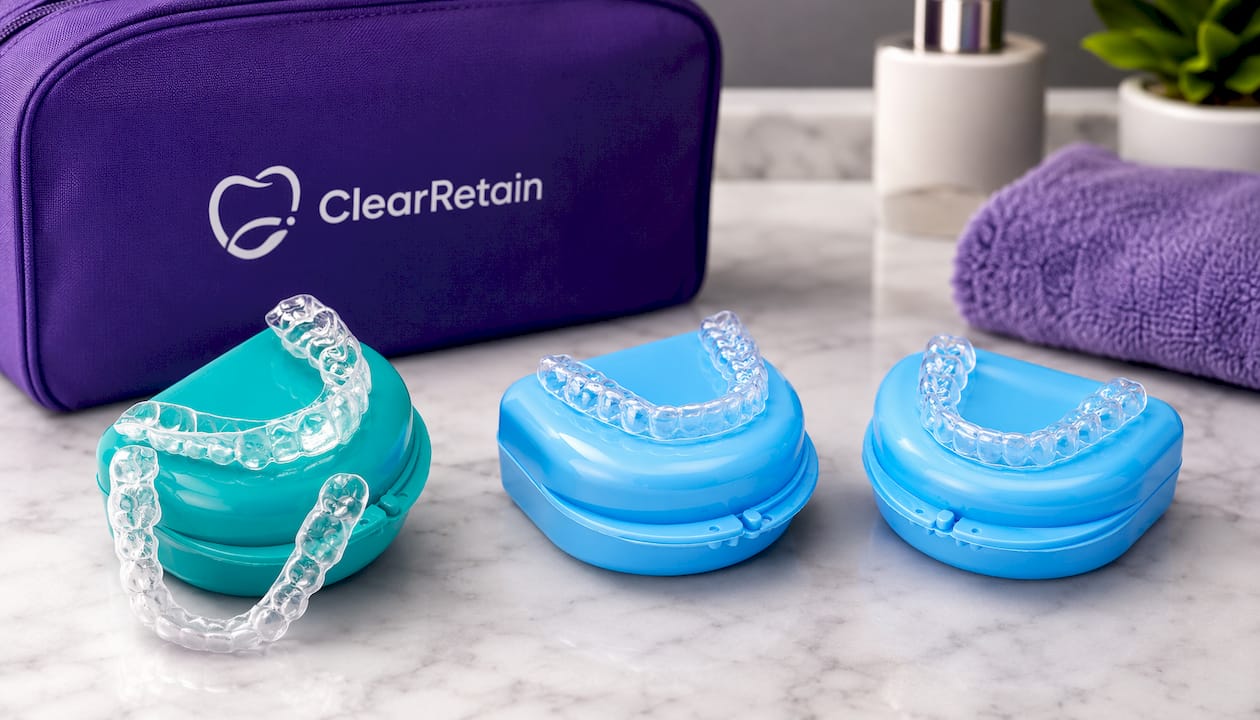
The Upper Teeth Retainer and Lower Teeth Retainer are available individually for patients who need a single-arch replacement. Each product page includes material and care information, and Clearretain’s customer service team can walk you through the documentation to request before purchase. The self-impression kit makes the process straightforward from home, with no office visit required.
If the article’s guidance on ISO 10993 testing, 510(k) clearance, and post-processing controls resonates with you, Clearretain is built around exactly those standards. Review the product pages, request the documentation that matters to you, and order with confidence that the materials and processes behind your retainer are the ones this article recommends.
Primary sources and further reading
The claims in this article are grounded in peer-reviewed systematic reviews and U.S. regulatory references. Key sources by section:
- Biocompatibility data, chemical leaching, and BPA evidence (Sections 4, 6): Biocompatibility and Safety of Orthodontic Clear Aligners and Thermoplastic Retainers: A Systematic In Vitro Review (2015–2025), Applied Sciences, 2025. Covers 17 in vitro studies on PET-G, TPU, multilayer polyurethanes, and printed resins.
- Material families, residual monomers, and endocrine disruption (Sections 2, 3, 4): Cytotoxicity and Endocrine Disruption in Materials Used for Removable Orthodontic Retainers: A Comprehensive Review, PMC. Covers PMMA, thermoformed thermoplastics, and printed resins with regulatory context.
- Comparative biocompatibility of PET-G, PP, PC, TPU, and EVA (Sections 5, 8): Effectiveness and Biocompatibility of Tooth Aligners Made from PeT-G, PP, PC, TPU, and EVA: A Systematic Review, PMC. Clinical and laboratory comparison across five thermoplastic families.
- U.S. dental device regulatory classification (Section 3): 21 CFR Part 872, Electronic Code of Federal Regulations. Governs classification of dental devices including retainers.
- Patient comfort and dental appliance concerns: Clayton Dental Studio patient concerns resource provides a patient-facing overview of common adaptation issues with dental appliances.