

Why Retainers Need Professional-Grade Plastic
Professional-grade plastic in dental retainers provides the durability, biocompatibility, and fit stability required for effective orthodontic retention. Without it, retainers crack, warp, and lose their shape, allowing teeth to shift back toward their original positions. The question of why retainers need professional-grade plastic comes down to material science: the polymer used determines how long your retainer lasts, how safe it is in your mouth, and whether it actually holds your teeth in place. Clearretain uses FDA-approved, BPA-free materials manufactured under the supervision of experienced orthodontic technicians, meeting the clinical standards that define a retainer worth wearing.
Why retainers need professional-grade plastic: material properties that matter
Professional-grade plastics used in retainers are defined by a specific set of chemical and physical properties that generic materials simply do not meet. The most critical of these is biocompatibility. Modern professional polymers maintain cell viability above 70% in standardized testing, meaning the material does not harm the soft tissues it contacts every night. Generic plastics often skip this evaluation entirely.
Beyond safety, the mechanical properties of the plastic determine how a retainer performs under real conditions. Your retainer flexes slightly every time you remove it, and it absorbs pressure from your bite while you sleep. Professional-grade materials are engineered for fatigue resistance, which means they return to their original shape after repeated flexing without developing micro-cracks. Mechanical fatigue at canine eminences and interproximal areas is the most common cause of retainer failure, and only materials with sufficient rigidity and flexibility can resist it.
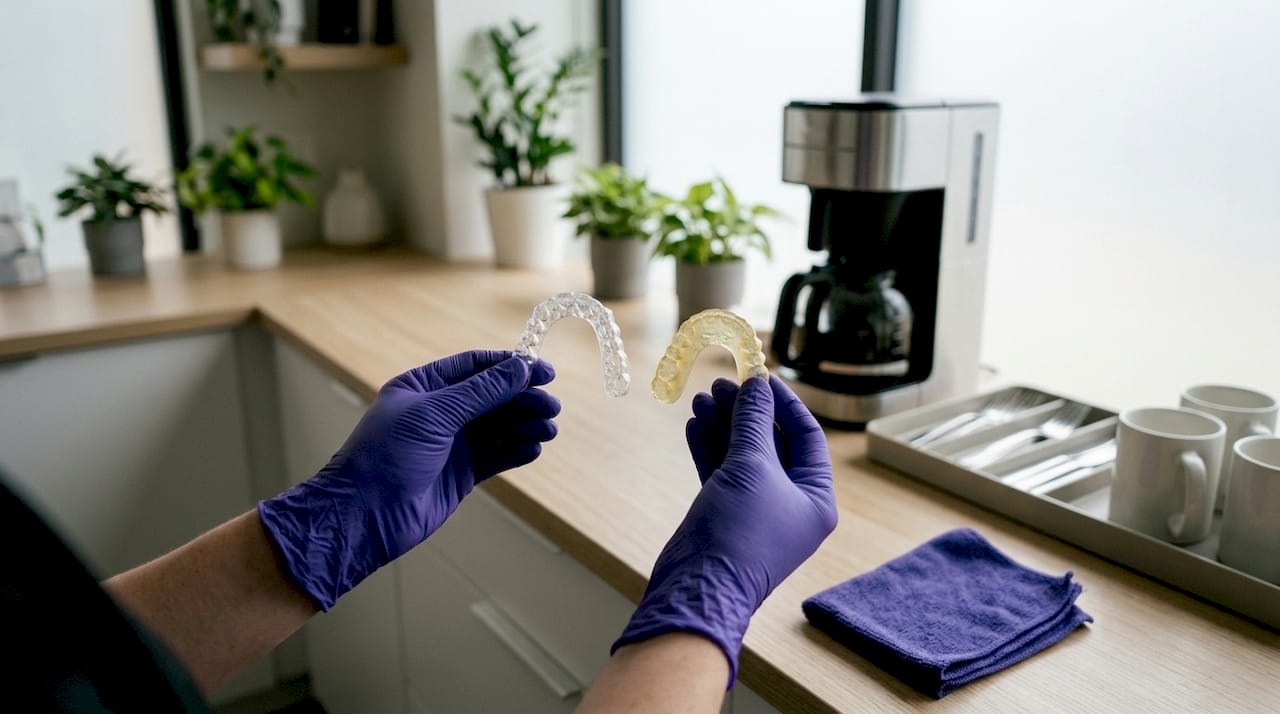
The oral environment is also chemically aggressive. Saliva, food acids, temperature swings between hot coffee and cold water, and the constant pressure of occlusal forces all degrade plastic over time. Professional-grade thermoplastic retainer materials are formulated to resist moisture absorption, surface wear, and discoloration under these conditions. A cheaper polymer absorbs pigments and moisture faster, creating biofilm buildup and accelerating material breakdown.
Manufacturing precision matters as much as the raw material. Calibrated thermoforming and validated post-curing protocols are critical for dimensional stability. Internal material stresses from improper thermoforming or incomplete resin curing cause warping under oral temperature fluctuations, even when the plastic itself is high quality. A retainer made from good plastic but manufactured carelessly will still fail.
Pro Tip: Ask your provider whether their retainers are made from BPA-free, thermoformed or validated 3D-print-cured materials. If they cannot answer that question, the material quality is likely not a priority in their process.
Key properties to look for in professional-grade retainer plastic:
- BPA-free polymer composition with documented biocompatibility testing
- Fatigue resistance to withstand repeated insertion and removal cycles
- Dimensional memory so the retainer returns to its exact shape after flexing
- Moisture and heat resistance to prevent warping and biofilm formation
- Manufacturing precision through calibrated thermoforming or validated curing
How do professional retainers compare to generic options?
The lifespan difference between professional and generic retainers is significant. Professional-grade clear retainers last 12–36 months with nightly use. Generic or low-grade alternatives often fail within months due to mechanical fatigue and micro-crack formation. That shorter lifespan is not just inconvenient. It is clinically dangerous, because a failed retainer means teeth begin moving.
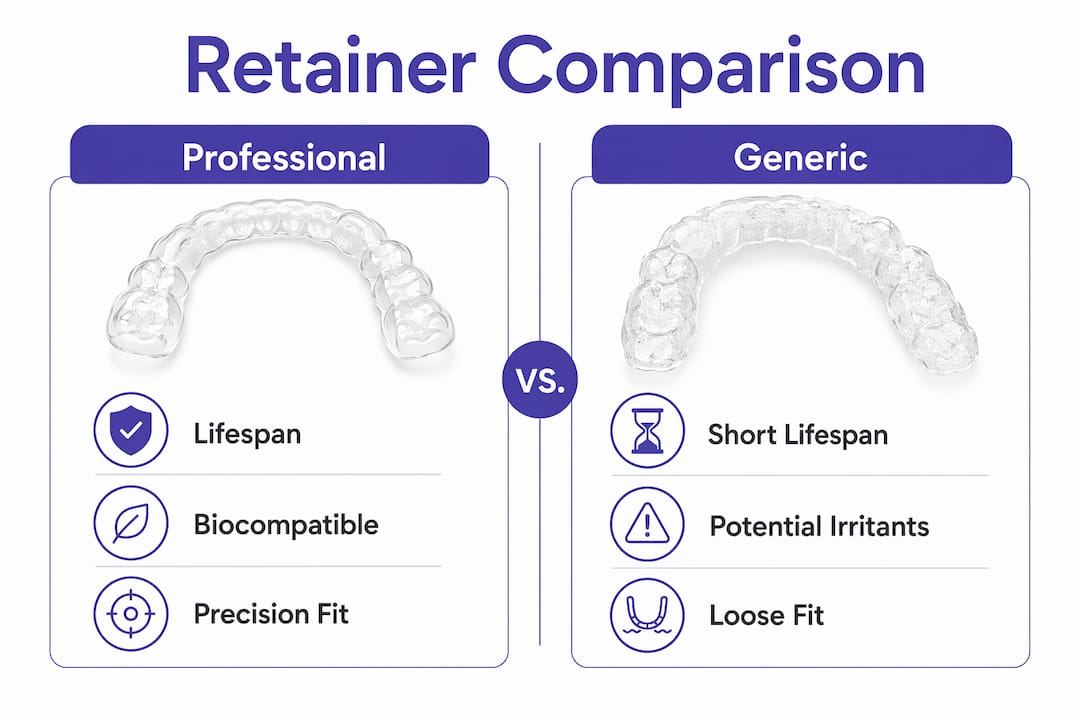
The failure mode of cheap plastic is particularly deceptive. Visible cracks originate in high-stress zones and propagate inward. A retainer can look intact while it has already lost the structural integrity needed to hold teeth in position. Patients who rely on a cracked retainer may not realize their teeth are shifting until the movement is visible.
Biocompatibility is another area where the gap is wide. Generic plastics sold through non-professional channels frequently lack thorough safety evaluation. The 2026 clinical guidance on aligner materials confirms that thermoformed materials from professional sources show better biocompatibility and safety for oral tissues compared to untested alternatives. Prolonged contact with cytotoxic plastic can irritate gum tissue and contribute to inflammation.
Fit stability separates professional retainers from generic ones in a practical way. Precision vacuum forming and validated post-curing protocols produce a retainer that adapts predictably to your dental arch. Generic alternatives may loosen over time as the plastic loses its dimensional memory, reducing retention force and allowing tooth relapse. The table below summarizes the key differences.
| Feature | Professional-grade retainer | Generic retainer |
|---|---|---|
| Typical lifespan | 12–36 months | Often fails within months |
| Biocompatibility | Tested, cell viability above 70% | Frequently untested |
| Crack resistance | High fatigue resistance | Prone to micro-cracks |
| Fit stability | Precision thermoformed or cured | May loosen over time |
| Heat resistance | Formulated for oral temperature range | Susceptible to warping |
For a detailed breakdown of how different retainer materials compare on longevity and performance, the differences go deeper than price.
How to choose and maintain quality retainers
Choosing a quality retainer starts before you place an order. The fabrication process is the first signal of material quality. Providers who use calibrated thermoforming equipment or validated 3D-print curing protocols are working to a clinical standard. Providers who cannot describe their manufacturing process are not.
Signs of a quality retainer in your hands include uniform thickness across the arch, smooth edges with no rough spots, and a snug fit with no rocking or gaps. A retainer that feels loose on day one was either made from poor material or fabricated imprecisely. Both problems lead to the same outcome: inadequate retention.
Maintenance directly affects how long a professional-grade retainer performs. Follow these steps to protect your investment:
- Rinse immediately after removal. Saliva dries into a film that promotes biofilm buildup. Rinsing with cool water removes it before it sets.
- Clean with a soft brush and mild soap. Toothpaste is abrasive and scratches the plastic surface, creating grooves where bacteria accumulate.
- Store in a ventilated case. Sealed cases trap moisture. A case with small air holes allows the retainer to dry between uses.
- Keep it away from heat. Thermal distortion from heat exposure causes misfit and potential tooth movement. Never leave your retainer in a hot car or rinse it with hot water.
- Inspect monthly for cracks. Hold the retainer up to a light source and look for hairline fractures near the canine areas and between teeth.
Pro Tip: If your retainer feels tighter than usual after a few days without wearing it, that is an early sign your teeth are shifting. Do not force it. Contact your provider to assess whether the retainer still fits correctly.
Replace your retainer when you see visible cracks, when it no longer fits snugly, or when discoloration becomes heavy and cannot be cleaned. The oral environment’s acidity and temperature variations degrade even professional-grade plastic over time. Waiting too long to replace a worn retainer risks tooth relapse that may require additional orthodontic treatment.
What emerging technologies are changing retainer materials?
3D printing is the most significant shift in retainer fabrication in the past decade. Direct 3D-printed retainers maintain clinical parity with thermoformed ones while offering micron-level accuracy, variable thickness for localized reinforcement, and the elimination of errors introduced by physical impressions. A retainer printed to a digital scan of your teeth fits more precisely than one formed over a physical plaster model.
The materials used in 3D printing are also advancing. Class IIa biocompatible resins formulated without BPA precursors are now available for orthodontic use. These resins allow manufacturers to build retainers with thicker walls in high-stress zones, like the canine areas where fatigue cracks most often begin, while keeping other areas thin for comfort.
The biocompatibility picture for 3D-printed materials is still developing. Some printed resins show moderate cytotoxicity at higher concentrations and longer exposure times, unlike thermoformed plastics, which show consistent biocompatibility profiles. This means the post-curing process for printed retainers is critical. Incomplete curing leaves residual monomers that can leach into saliva.
- Digital workflows reduce human error in every step from scan to finished retainer
- Variable thickness printing reinforces stress zones without adding bulk elsewhere
- Class IIa resins meet medical device standards for intraoral contact
- Ongoing cytotoxicity research is refining which resin formulations are safest for long-term wear
One area of active research involves micro and nanoplastic particles released from retainers under heavy use, particularly in patients with bruxism. Clinical monitoring for this type of material degradation is becoming part of standard orthodontic follow-up. Professional-grade materials are formulated to minimize particle release, but no plastic is entirely inert under sustained mechanical stress.
Key Takeaways
Professional-grade plastic is the single most important factor in whether a retainer holds your teeth in place safely and long enough to justify the cost.
| Point | Details |
|---|---|
| Material quality determines lifespan | Professional-grade retainers last 12–36 months; generic options often fail within months. |
| Biocompatibility is non-negotiable | Tested polymers maintain cell viability above 70%, protecting oral tissues from irritation. |
| Manufacturing precision matters | Calibrated thermoforming and validated curing prevent warping and dimensional failure. |
| Maintenance extends retainer life | Avoiding heat, cleaning correctly, and inspecting monthly prevents premature failure. |
| 3D printing raises the standard | Digital fabrication with Class IIa resins improves fit accuracy and localized reinforcement. |
What I have learned from years of watching retainers fail
The most common mistake people make is treating a retainer as a commodity. They see a low price and assume the product is equivalent to what their orthodontist provided. It is not. The plastic is different, the manufacturing process is different, and the clinical outcome is different.
What I find most telling is the failure pattern. A cheap retainer does not announce itself as failing. It looks fine. It feels fine. Then one day it does not fit quite right, and by the time the patient notices, the teeth have already moved. That is the real cost of a generic retainer: not the replacement cost, but the orthodontic treatment needed to correct the relapse.
The other misconception I see regularly is that maintenance can compensate for poor material quality. It cannot. You can care perfectly for a retainer made from low-grade plastic and it will still micro-crack at the canine eminences within months. Good habits extend the life of a good retainer. They cannot save a bad one.
My honest recommendation is to treat your retainer the way you treat any medical device. Ask what it is made of. Ask how it was manufactured. Ask whether the materials meet current biocompatibility standards. Those questions are not excessive. They are the minimum due diligence for something you wear in your mouth every night for years.
— Clear
Clearretain’s professional-grade retainers: built to last
Clearretain manufactures its retainers from FDA-approved, BPA-free materials under the supervision of experienced orthodontic technicians, meeting the clinical standards outlined in 2026 guidance on retainer material safety. Every retainer is fabricated with calibrated precision to deliver the fit stability and fatigue resistance that professional-grade plastic requires.
Whether you need a premium upper retainer or a complete upper and lower retainer set, Clearretain delivers professional quality directly to your door at a fraction of the cost of traditional orthodontic offices. For patients who need a replacement, the clear upper retainer option provides the same medical-grade material at a price that makes staying consistent with retention realistic. Order online with a detailed self-impression kit and skip the office markup entirely.
FAQ
What plastic is used in professional-grade retainers?
Professional-grade retainers use BPA-free, biocompatible thermoplastic polymers or Class IIa resins that meet medical device standards for intraoral contact. These materials are tested to maintain cell viability above 70% in standardized biocompatibility evaluations.
How long does a professional-grade retainer last?
A professional-grade clear retainer lasts 12–36 months with nightly use. Generic retainers made from lower-quality plastic often fail within months due to micro-crack formation and mechanical fatigue.
Can heat damage a professional retainer?
Yes. Thermal distortion from heat exposure causes warping and misfit even in professional-grade retainers. Never rinse your retainer with hot water, run it through a dishwasher, or leave it in a hot car.
What is the difference between professional and DIY retainers?
Professional retainers use tested, biocompatible materials and precision manufacturing processes. Generic or DIY retainer options frequently skip biocompatibility testing and use lower-grade plastics that warp, crack, and lose retention force faster.
When should I replace my retainer?
Replace your retainer when you see visible cracks, when it no longer fits snugly against your teeth, or when discoloration is heavy and persistent. Waiting too long risks tooth relapse that may require additional orthodontic correction.