

Impact Resistance in Dental Guards: An Athlete's Guide
Impact resistance in a mouthguard is its ability to reduce peak force on your teeth by damping energy, spreading that force over time, and distributing the load across the full dental arch. For athletes, the bottom line is straightforward: a custom-fitted, well-fabricated guard with appropriate thickness or an optimally layered construction gives you the best protection available. A systematic review found that non-users were substantially more likely to sustain orofacial injuries compared to mouthguard users. The FDI World Dental Federation and the American Dental Association both recommend guards that combine energy absorption with accurate fit and biocompatible materials.
Key facts up front:
- Impact resistance is not a single property. It combines material damping, structural design, thickness, and fit.
- Custom-made guards consistently outperform stock and boil-and-bite options in lab and clinical evidence.
- The risk ratio of 2.33 reported in systematic review data means non-users face more than twice the orofacial injury risk compared to mouthguard wearers.
Key Takeaways
Custom-fitted guards with optimized layered construction are the most evidence-backed choice for athletes, with non-users experiencing more than double the orofacial injury risk of mouthguard users according to systematic review data (risk ratio 2.33).
| Point | Details |
|---|---|
| Impact resistance defined | Force damping plus temporal spreading plus load distribution across the arch working together. |
| Risk reduction evidence | A systematic review found a risk ratio of 2.33 for non-users versus users in cohort data. |
| Design features that matter | Labial inserts, air spaces, and dual-layer construction reduce tooth deflection more than bulk alone. |
| Custom vs. off-the-shelf | Custom guards provide superior fit, retention, and consistent thickness, making them the gold standard. |
| Clearretain options | The Hard-Soft Night Guard (Dual Layer) and Premium Hard Night Guard address the FDI-recommended architecture for athletes. |
Table of Contents
- What does impact resistance actually mean for athletes?
- How labs measure impact resistance in mouthguards
- Which design features actually raise impact resistance?
- Custom-made vs. boil-and-bite vs. stock: what protection should you expect?
- Balancing protection with comfort, breathing, and compliance
- How to choose the right guard for your sport
- How to maintain impact resistance over time
- What the research says and where uncertainty remains
- Clearretain’s sports mouthguard options for athletes
- Why Clearretain recommends this approach
- Sources
What does impact resistance actually mean for athletes?
When a ball, elbow, or hard surface hits your face, it delivers a force measured in Newtons (N) over a very short time. The product of that force and time is impulse, measured in Newton-seconds (Ns). A guard with high impact resistance does two things: it lowers the peak force reaching your teeth, and it stretches the impact event over a longer time window so the instantaneous stress on enamel and bone stays below the threshold for fracture.
Load distribution matters just as much. A guard that covers the full maxillary arch spreads the blow across multiple teeth and the jaw rather than concentrating it on one incisor. Stabilizing the jaw in maximum intercuspal position, where upper and lower teeth mesh together, further reduces the chance that a direct blow causes condylar fracture or TMJ injury.
The systematic review data showing a risk ratio of 2.33 is the clearest clinical confirmation that these physics translate to real-world injury reduction. Lab numbers explain the mechanism; that cohort figure explains why it matters on the field.
How labs measure impact resistance in mouthguards
Researchers use several test setups to generate the numbers you might see in a product claim or study abstract.
- Ball-drop tests: A weighted ball falls from a fixed height onto a guard-covered tooth model. Sensors record maximum force (N) and the force-time curve. One ball-drop study recorded maximum force of approximately 2,470 N with conventional thermoformed laminates versus 8,982 N with no guard.
- Pendulum/blow devices: A swinging arm delivers a controlled lateral impact. Useful for simulating a punch or elbow strike.
- Laser Doppler and acceleration sensors: Measure tooth deflection in micrometers and braking acceleration, giving a direct read on how much the tooth actually moves.
- Finite element analysis (FEA): A computer model calculates Von-Mises stress (MPa) across enamel, dentin, and bone under simulated loads. FEA modeling showed customized guards reduced stress on skull, teeth, and jaw more than stock guards across tested thicknesses.
The key metrics to look for in a test report are percentage force reduction versus no guard, peak force in Newtons, and tooth deflection. A guard claiming “superior protection” without citing at least one of these figures is not giving you enough to evaluate.
Pro Tip: In vitro tests simplify real impacts. Lab results tell you which design direction is better, not the exact force your teeth will experience in a game. Use them to compare guard types, not to predict exact injury thresholds.
Which design features actually raise impact resistance?
Material choice and structural architecture drive most of the difference. The FDI’s guidance is clear: a high-performing guard combines a soft, compressible layer that absorbs energy with a harder component that bends and redistributes load across the arch.
Common materials and their roles:
- EVA thermoplastics and polyolefins: The workhorses of thermoformed guards. Good damping properties, well-understood fabrication. Material trade-offs between EVA grades affect stiffness and energy absorption.
- PETG and nylon mesh inserts: Placed in the labial (front) zone to stiffen that region without adding bulk everywhere.
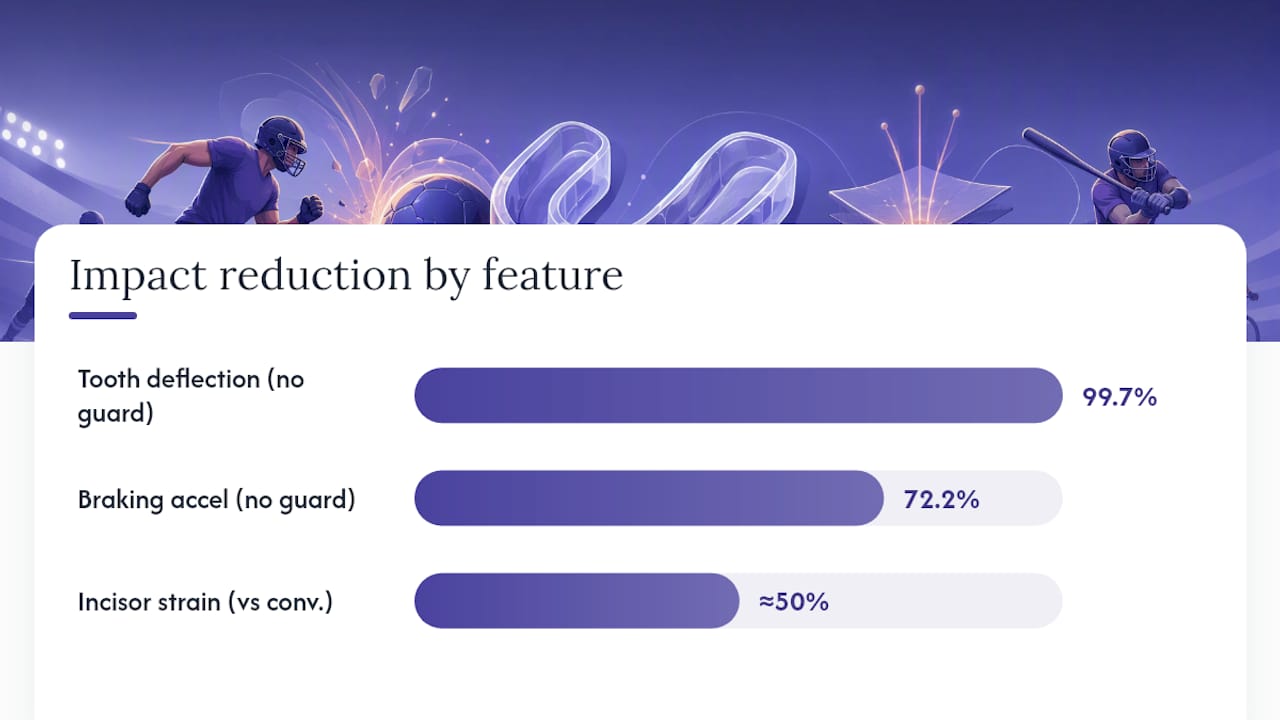
- Air spaces: A deliberate gap in the frontal zone creates a crumple zone. Combined with a labial insert, this architecture reduced tooth deflection by up to 99.7% and braking acceleration by up to 72.2% in lab testing versus no guard.
- 3D-printed composite resins: Emerging option. A 2024 study found a 3D-printed guard with a hard insert plus frontal space attenuated incisor strain roughly 50% more than a conventional bulkier design in that specific test configuration.
Thickness adds damping, but it is not the only lever. A strategically reinforced thinner guard can outperform a uniform thick one because the insert redirects load while the air space absorbs it.
Pro Tip: Ask specifically about labial thickness in millimeters and whether a hard insert or internal reinforcement is present. Those two details tell you more about real-world protection than overall guard thickness alone.
Custom-made vs. boil-and-bite vs. stock: what protection should you expect?
The European Association for Sports Dentistry position statement identifies custom-made guards as the gold standard, and the biomechanical evidence backs that up. Custom guards are fabricated over a precise model of your teeth, which means consistent thickness, full arch coverage, and retention that keeps the guard in place under impact. A guard that shifts or pops out during contact offers no protection at that moment.
| Evaluation dimension | Custom-made | Boil-and-bite | Stock |
|---|---|---|---|
| Force reduction | Highest, consistent | Variable | Lowest, inconsistent |
| Temporal spreading | Optimized by design | Depends on fit | Minimal |
| Fit and retention | Precise | Approximate | Poor |
| Comfort and communication | Best | Moderate | Worst |
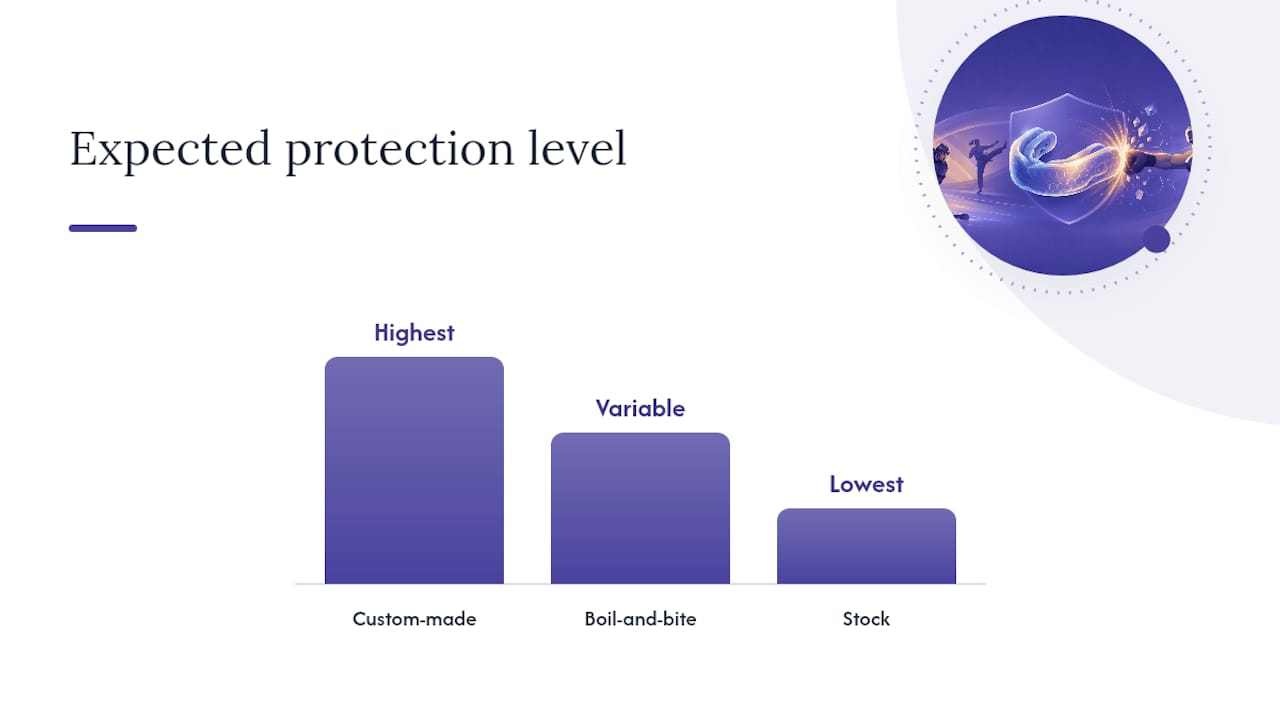
Boil-and-bite guards can provide meaningful protection when a custom guard is unavailable, but uneven thickness after self-fitting creates weak zones. Stock guards require the athlete to clench to hold them in place, which affects breathing and communication. Any well-fitting guard is better than none, but the fit gap between custom and off-the-shelf is real and measurable. See the custom vs. boil-and-bite comparison for a deeper breakdown.
Balancing protection with comfort, breathing, and compliance
A guard you refuse to wear protects nothing. Thickness increases damping but also increases bulk, which affects breathing and speech. Stiffer guards behave differently at low versus high impact energies, and a guard with poor retention can be displaced by the very impact it was supposed to absorb.
Sport-specific priorities matter here. Full-contact sports like boxing, rugby, and hockey justify a thicker, reinforced design because the frequency and severity of impacts are high. Non-contact or limited-contact sports may allow a thinner profile that athletes tolerate better during extended play.
Pro Tip: Fit and retention are as important as material specs. A guard with slightly lower lab-measured force reduction that stays in place during a collision will outperform a technically superior guard that dislodges on first contact. Prioritize fit first, then material architecture.
For athletes concerned about breathing during high-intensity play, ventilated guard designs offer a middle ground between protection and airflow.
How to choose the right guard for your sport
- Assess your contact level. Full-contact sports demand the highest impact resistance standards. Identify whether your sport involves frequent high-energy impacts or occasional incidental contact.
- Insist on custom fit for high-impact exposure. If you play contact sports regularly, a custom-fabricated guard is the right starting point, not a compromise.
- Confirm labial thickness and reinforcement. Ask for the labial thickness in millimeters. Ask whether a hard insert or internal reinforcement is present in the frontal zone.
- Ask about air-space design. A frontal air space combined with a labial insert is the configuration with the strongest lab evidence for tooth deflection reduction.
- Verify materials and fabrication standards. The ADA specifies high-impact energy absorption, accurate adaptation, and biocompatible materials as required characteristics.
Questions worth asking your vendor: What lab tests back this guard? What is the labial thickness in mm? Is there a hard insert or dual-layer construction? How is retention verified after fabrication?
How to maintain impact resistance over time
Thermoplastic materials degrade with heat, chemical exposure, and repeated compression. Protecting that performance means treating the guard correctly between uses.
- Rinse with cool water immediately after use. Hot water warps thermoplastics and permanently changes the fit.
- Clean with mild soap and a soft brush. Avoid alcohol-based mouthwashes, which can dry out and weaken the material.
- Store in a ventilated hard case away from direct sunlight and heat sources.
- Inspect before every session for cracks, permanent deformations, thinning at the labial zone, or loss of retention. Any of these signals reduced protection.
- Replace after significant impacts, visible wear, or any change in dentition. A guard that no longer fits precisely no longer distributes force correctly.
For detailed replacement indicators, the Clearretain replacement guide covers the full checklist.
Pro Tip: Keep a second guard for heavy training sessions and reserve your primary custom guard for competition. Rotating guards extends the life of your best-fitting appliance and means you always have a backup.
What the research says and where uncertainty remains
The evidence base for mouthguard protection is solid at the physics level and consistent in its clinical direction, but it has real limits.
The systematic review reporting a risk ratio of 2.33 is the strongest clinical signal available. Lab studies consistently show percentage force reductions and tooth deflection improvements with guards versus no guard. FEA modeling confirms that custom guards and increased thickness reduce stress on teeth and jaw structures more than stock options. The insert-plus-air-space architecture has strong in vitro support.
Limits worth knowing:
- Most impact tests are in vitro. Real-world impacts vary in angle, energy, and contact geometry in ways lab setups cannot fully replicate.
- Test protocols differ across studies, making direct comparisons between guard brands difficult.
- Additive-manufactured resins show promise but conventional thermoformed laminates still outperform them at comparable thicknesses in current testing. AM materials are not yet consistently superior.
- More high-quality randomized clinical trials are needed to confirm which specific design features drive the largest injury reduction in real match conditions.
Clearretain’s sports mouthguard options for athletes
Custom fit from a precise impression is the foundation of everything discussed in this article, and that is exactly where Clearretain starts. Every guard is fabricated from FDA-approved materials under the supervision of experienced orthodontic technicians, with digital impressions stored for consistent reorders.
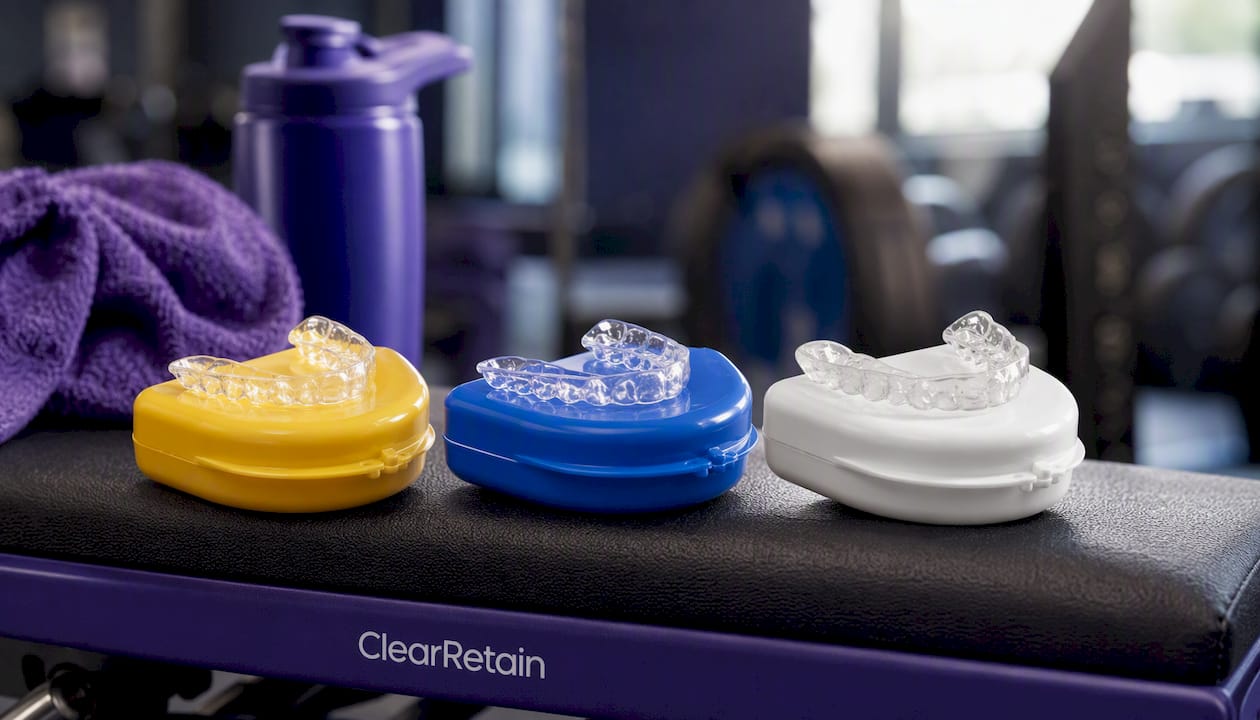
Three guard constructions map directly to the protection levels athletes need:
- Premium Hard Night Guard: Full hard construction for athletes who need maximum frontal stiffness and retention under high-impact conditions or heavy grinding loads.
- Hard Night Guard: Single-material hard guard suited to high-impact sports where a firm, stable surface is the priority.
- Hard-Soft Night Guard (Dual Layer): The dual-layer design that matches the FDI-recommended architecture: a soft compressible layer paired with a harder distributing layer for athletes who want both damping and stiffness.
Order online with Clearretain’s at-home impression kit, specify your sport and contact level, and your guard ships fast. Stored digital scans mean reorders maintain the same fabrication precision. Start your order at Clearretain’s sports guard page.
Why Clearretain recommends this approach
At Clearretain, the design choices behind our guards come directly from the evidence reviewed in this article. Digital impressions eliminate the fit variability that undermines protection in stock and self-fitted options. Quality-controlled fabrication means the labial thickness and layer architecture you order are what you actually receive, not an approximation. For athletes unsure which construction suits their sport or contact level, our customer support team can walk through the options and help match the guard to the specific demands of your activity.
Sources
The sources below are listed in order of practical usefulness for athletes making a buying decision, followed by the technical studies for those who want the full methodology.
- The use of mouthguards significantly reduces the overall risk of orofacial injuries (systematic review / meta-analysis)
- Sports mouthguards - FDI World Dental Federation
- Position Statement and Recommendations for Custom‐Made Sport Mouthguards - PMC
- Influence of custom-made and stock mouthguard thickness on biomechanical response to a simulated impact
- Laboratory study on mouthguard materials, inserts, and design features (impact testing)
- Design of Customized Mouthguards with Superior Protection Using Digital-Based Technologies and Impact Tests
- In vitro comparison of conventional and additively manufactured mouthguard materials (ball-drop experiments) - Materials (MDPI)
- Athletic Mouth Protectors (Mouthguards) | American Dental Association
This article is general information, not a substitute for advice from a qualified doctor. Consult a qualified healthcare professional about your own circumstances before acting on anything here.