


Perforated Ventilated Mouth Guard: Athlete's Guide
A perforated ventilated mouth guard is a protective oral device built with strategically placed holes or channels that allow continuous airflow, making it possible to breathe, speak, and drink without removing it during physical activity. Unlike traditional guards, this design solves the most common complaint athletes have: the feeling of being suffocated or silenced mid-game. If you’ve ever pulled out your mouth guard just to catch your breath or call a play, you already understand the problem this product solves.
What is a perforated ventilated mouth guard?
A perforated ventilated mouth guard is defined as a dental protector that uses holes or channels for airflow rather than relying on bulk alone for protection. The industry also refers to these as ventilated dental guards or aerated sport guards. Brands like SISU have built their entire product line around this concept, proving that thinner, perforated designs can deliver real protection without the bulk of older models.
The perforations are not random. They are placed to maintain structural integrity while opening pathways for air and moisture. This means you get a guard that protects your teeth and jaw while still letting you breathe naturally through your mouth. For contact sports like Brazilian jiu-jitsu, MMA, football, and basketball, that combination is not a luxury. It’s a performance factor.
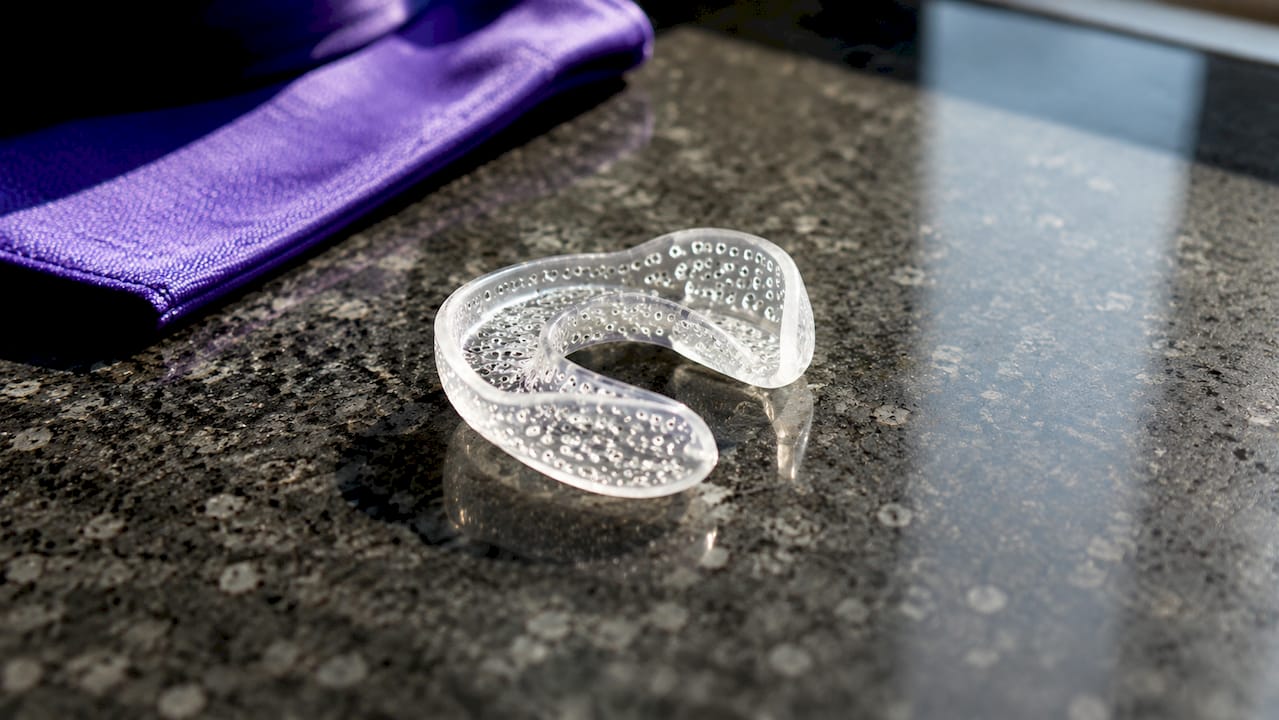
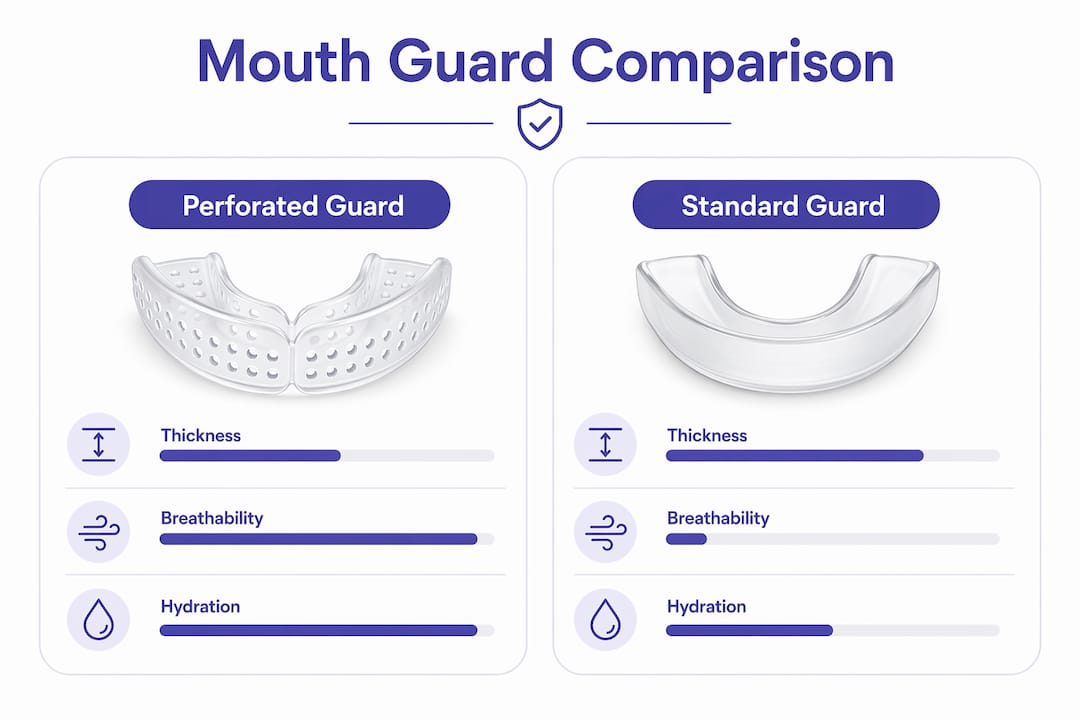
Standard guards typically run 3–5 mm thick. Perforated designs sit around 1.6 mm, which is a dramatic reduction in material. That thinner profile changes how the guard feels, how clearly you can speak, and how easily you can hydrate mid-match.
How does perforated design improve breathing, speaking, and hydration?
The core functional advantage of a ventilated dental guard is simple: air moves through the guard instead of around it. Traditional thick guards force athletes to breathe almost entirely through the nose, which limits oxygen intake during high-intensity effort. Perforations eliminate that restriction.
Perforated guards allow athletes to drink water without removing the device. That single feature reduces two real problems: hygiene risk from a guard sitting on a bench or floor, and the performance interruption of stopping to pull the guard out. In a wrestling match or a basketball game, those seconds matter.
Speech clarity improves for the same reason airflow improves. Thick guards push the tongue down and force the jaw open slightly, distorting words. Perforated designs sit closer to the teeth and preserve natural tongue posture. Performance-focused athletes prefer guards that maintain natural tongue posture and lip seal because these factors support overall postural stability, not just communication.
Pro Tip: If you coach a team sport, a ventilated guard is worth specifying for your players. Athletes who can call plays and hear instructions without removing their guard stay safer and perform better.
Perforated vs. standard mouth guard: key differences
| Feature | Perforated Ventilated Guard | Standard Thick Guard |
|---|---|---|
| Thickness | ~1.6 mm | 3–5 mm |
| Airflow | Continuous through perforations | Restricted, nose-only breathing |
| Speech clarity | High, near-natural | Reduced, often muffled |
| Hydration | Drink without removal | Must remove to drink |
| Gag reflex risk | Low | Higher due to bulk |
| Energy distribution | Through perforation geometry | Through material thickness |
What materials and thicknesses are standard for these guards?
Perforated ventilated mouth guards are most commonly made from thermoplastic materials, including ethylene vinyl acetate (EVA) and polyurethane-based compounds. These materials soften when heated, allowing them to mold precisely to the teeth and gums. The molding process is what makes the perforation pattern effective. A guard that fits poorly will shift during impact, and the perforations will no longer align with the intended airflow paths.
Mouth-formed guards adapt to intraoral anatomy but can compromise ventilation if the thermoplastic fills the perforations during the molding process. This is why material selection matters. Higher-quality thermoplastics hold their shape around the perforations during heat forming, preserving the airflow channels after the guard cools.
Intelligent energy distribution through perforation design rather than thickness is the key principle behind effective perforated guards. The geometry of the holes absorbs and redirects impact force across a wider surface area. This is the same principle used in modern helmet padding and athletic shoe soles.
Pro Tip: When fitting a boil-and-bite perforated guard, use water at the lower end of the recommended temperature range. Overheating softens the material too much and risks collapsing the perforations.
Material and performance summary
| Material | Molding Method | Perforation Retention | Best Use |
|---|---|---|---|
| EVA thermoplastic | Boil-and-bite | Moderate | Recreational sports |
| Polyurethane | Custom lab-formed | High | Combat sports, high contact |
| 3D-printed resin | Digital scanning | Precise | Custom professional use |
| Dual-layer composite | Lab-formed | High | Mixed protection needs |
3D printing technology now allows custom guards to incorporate precise ventilation channels while maintaining a perfect fit. This advancement means athletes no longer have to choose between breathability and protection.
How do perforated guards compare to boil-and-bite and custom models?
Three main categories of mouth guards exist: stock (ready-to-wear), boil-and-bite, and custom-made. Perforated ventilation features appear across all three, but their effectiveness varies significantly by category.
Stock guards come pre-formed and require no fitting. They offer the lowest cost but the worst fit. Perforations in stock guards are often decorative rather than functional because the guard does not conform to the wearer’s teeth, leaving gaps that reduce protection.
Boil-and-bite guards are the most common choice for recreational athletes. You soften them in hot water and bite down to create a rough impression. Perforated boil-and-bite models, like those from SISU, deliver real breathability improvements over standard versions. The fit is better than stock but still less precise than custom.
Custom-made guards are the gold standard. Custom mouthguards provide superior comfort, reduce gag reflex symptoms, and maintain oral health better than standard or boil-and-bite types. When ventilation channels are built into a custom guard, they stay open and aligned because the guard fits exactly. This is the category where perforated design delivers its full potential.
Choosing between these options comes down to three factors:
- Sport type: High-contact sports like boxing or MMA justify the cost of a custom perforated guard. Lower-contact sports like soccer or field hockey may be well-served by a quality boil-and-bite perforated model.
- Speech requirements: Coaches, quarterbacks, and players who need to communicate constantly benefit most from custom ventilated designs.
- Budget and frequency: Competitive athletes who train daily should invest in custom. Recreational players can start with a quality boil-and-bite perforated option and upgrade as needed.
How should you select and maintain a perforated mouth guard?
Selecting the right guard starts with matching the product to your sport and your anatomy. A guard that fits loosely will shift on impact, and a guard that fits too tightly will cause jaw fatigue. Here is a practical selection and care process:
- Identify your contact level. Full-contact sports require thicker custom guards. Semi-contact sports work well with quality boil-and-bite perforated models.
- Check perforation placement. Look for guards where holes or channels run through the biting surface and the front face. Guards with perforations only on the sides offer less airflow benefit.
- Fit the guard properly. Follow the manufacturer’s instructions exactly. For boil-and-bite models, bite firmly and use your fingers to press the material against your teeth and gums for a full 30 seconds.
- Rinse after every use. Use cool water and a soft toothbrush with mild soap. Avoid hot water, which can warp the material and close the perforations.
- Apply an antimicrobial rinse weekly. Maintaining a ventilated mouthguard involves rinsing, gentle brushing, antimicrobial sprays, and storing in ventilated cases to allow drying and prevent mold growth.
- Store in a ventilated case. A sealed container traps moisture and promotes bacterial growth. Use a case with air holes or leave the lid slightly open.
- Inspect monthly. Signs for replacing mouthguards include fit loosening, material thinning, and hygiene deterioration. If the guard rocks on your teeth or shows visible wear, replace it.
Pro Tip: Label your guard case with your name and the date you started using the guard. Most guards last 6–12 months with regular use. Tracking the start date removes the guesswork on replacement timing.
Key takeaways
A perforated ventilated mouth guard delivers better protection, comfort, and compliance than standard thick guards because its perforation geometry distributes impact force while keeping airflow open.
| Point | Details |
|---|---|
| Core design advantage | Perforations allow continuous airflow, speech, and hydration without removing the guard. |
| Thickness matters | Perforated guards run ~1.6 mm thick versus 3–5 mm for standard guards, improving comfort significantly. |
| Custom beats boil-and-bite | Custom guards preserve ventilation channels precisely, delivering the full benefit of perforated design. |
| Material choice affects performance | Polyurethane and 3D-printed resins hold perforation shape better than basic EVA during molding. |
| Maintenance extends lifespan | Antimicrobial rinses, ventilated storage, and monthly inspections keep guards safe and functional. |
Why ventilated guards changed how i think about mouth protection
The most common objection I hear about mouth guards is that they’re too bulky to wear consistently. Athletes pull them out between plays, tuck them in their jersey, and forget to put them back in. That habit is where most dental injuries happen. The guard sitting on the bench cannot protect the teeth on the field.
Perforated ventilated designs solve a compliance problem more than a comfort problem. When a guard does not obstruct breathing or speech, athletes actually wear it. That shift in behavior is worth more than any marginal difference in material thickness or perforation geometry.
The misconception I see most often is that thinner means weaker. Standard thick guards can increase gag reflex and obstruct speech without delivering better protection. Bulk is not the same as protection. A well-engineered perforated guard at 1.6 mm can outperform a poorly fitted 4 mm guard on every practical measure.
For parents buying guards for young athletes, the ventilated option is worth the small price difference. A guard a child will actually wear is always the right choice.
— Clear
Get a custom ventilated guard from Clearretain
Clearretain builds custom sport mouth guards designed for athletes who need real protection without sacrificing breathability. Every guard is made from FDA-approved materials under the supervision of experienced orthodontic technicians, and the at-home impression process means you get a precise fit without an office visit.

If you also grind at night, Clearretain’s night guard options include ventilated designs built for all-night comfort. Orders ship fast, cost up to 80% less than traditional orthodontic pricing, and come with detailed fitting instructions so you get it right the first time.
FAQ
What is a perforated ventilated mouth guard?
A perforated ventilated mouth guard is a protective oral device with built-in holes or channels that allow airflow during physical activity. It enables breathing, speaking, and drinking without removal, while still protecting teeth and jaw from impact.
Are perforated mouth guards as protective as standard ones?
Yes. Perforated designs use perforation geometry to distribute impact energy across a wider surface area rather than relying on bulk. A well-fitted perforated guard at 1.6 mm provides effective protection comparable to standard 3–5 mm models.
How do i fit a boil-and-bite perforated mouth guard?
Soften the guard in hot water at the manufacturer’s recommended temperature, bite down firmly, and press the material against your teeth and gums for 30 seconds. Avoid overheating, which can collapse the perforations and reduce airflow.
How often should i replace my ventilated mouth guard?
Replace your guard when the fit loosens, the material thins, or hygiene cannot be restored through cleaning. Most guards last 6–12 months with regular use and proper care.
Can kids use perforated ventilated mouth guards?
Yes. Perforated guards are a strong choice for young athletes because the improved breathability and speech clarity increase the likelihood they will wear the guard consistently, which is the most important factor in injury prevention.