

Mouth Guard Materials Comparison: What Buyers Need to Know
For sports protection, soft EVA is the right call. For severe bruxism or TMJ symptoms, hard PMMA acrylic is the clinical standard. For moderate grinding where comfort matters as much as durability, a dual-laminate design splits the difference. That’s the short version of any honest mouth guard materials comparison, and it’s backed by the same framework dentists use when selecting appliances for their patients.
Any guard worth buying should be made from FDA-approved medical-grade materials and tested against ISO 10993 biocompatibility standards, which evaluate cytotoxicity, sensitization, and systemic toxicity before a material ever touches your mouth.
| Use Case | Best Material | Protection Level | Typical Lifespan |
|---|---|---|---|
| Contact sports | Soft EVA | Impact absorption | Moderate lifespan |
| Mild clenching | Soft EVA or copolyester | Moderate | Moderate lifespan |
| Moderate bruxism | Dual-laminate (hard/soft) | High | Longer lifespan than soft |
| Severe grinding / TMJ | Hard PMMA acrylic | Maximum | Long-lasting lifespan |
Pro Tip: If you grind heavily and your dentist gave you a soft guard, ask why. Soft elastomers can trigger the chewing reflex, where the brain reads the pliable material as food and keeps the jaw muscles working. For heavy grinders, that can make soreness worse, not better.
Table of Contents
- How each mouth guard material actually performs
- Why material choice changes your clinical outcome
- Are mouth guard materials actually safe?
- How to pick the right material for your situation
- Cleaning, storage, and knowing when to replace
- Why dual-laminate guards are often the practical compromise
- Key Takeaways
- The material question most buyers get wrong
- Clearretain’s custom guards match every material tier
- Useful sources for further reading
How each mouth guard material actually performs
The six materials you’ll encounter in dental appliances are EVA, PMMA acrylic, copolyester, TPU/hybrid laminates, silicone, and standard thermoplastics. Each behaves differently under load, ages differently in your mouth, and presents different hygiene challenges.
EVA (Ethylene Vinyl Acetate) EVA is the workhorse of sports mouth guards and mild-use night guards. Its elastic modulus sits around 0.01–0.02 GPa, making it highly flexible and comfortable from the first wear. Shore A hardness typically ranges 70–95 depending on formulation. Medical-grade EVA is BPA-free, BPS-free, phthalate-free, and latex-free, and the National Toxicology Program has not classified it as carcinogenic. The downside: its surface porosity increases over time, which raises bacterial adhesion and makes thorough cleaning harder. Expect replacement within about a year depending on use.
PMMA (Heat-Cured Acrylic) Hard acrylic is the gold standard for severe bruxism. PMMA’s flexural strength commonly exceeds 110 MPa, its elastic modulus runs around 3.2 GPa, and its surface hardness sits at roughly 18–20 KHN. Those numbers mean it can handle occlusal forces above 800N without deforming, which is why dentists rely on it for patients with heavy grinding patterns or existing restorations they need to protect. Heat-cured PMMA generally outlasts other materials and can last several years with proper care. It’s fabricated by pouring liquid resin into a mold and polymerizing it under heat and pressure, a process that drives off residual monomer and reduces the MMA exposure risk that cold-cure methods carry.
Copolyester Copolyesters are thermoplastic resins that thermoform well under heat, producing a rigid, acrylic-like result without the MMA concerns. Material Safety Data Sheets report no toxicity for copolyesters, and they bond to other materials, which makes them useful in hybrid constructions. They’re a solid alternative when a patient needs rigidity but has sensitivities to traditional acrylic chemistry.
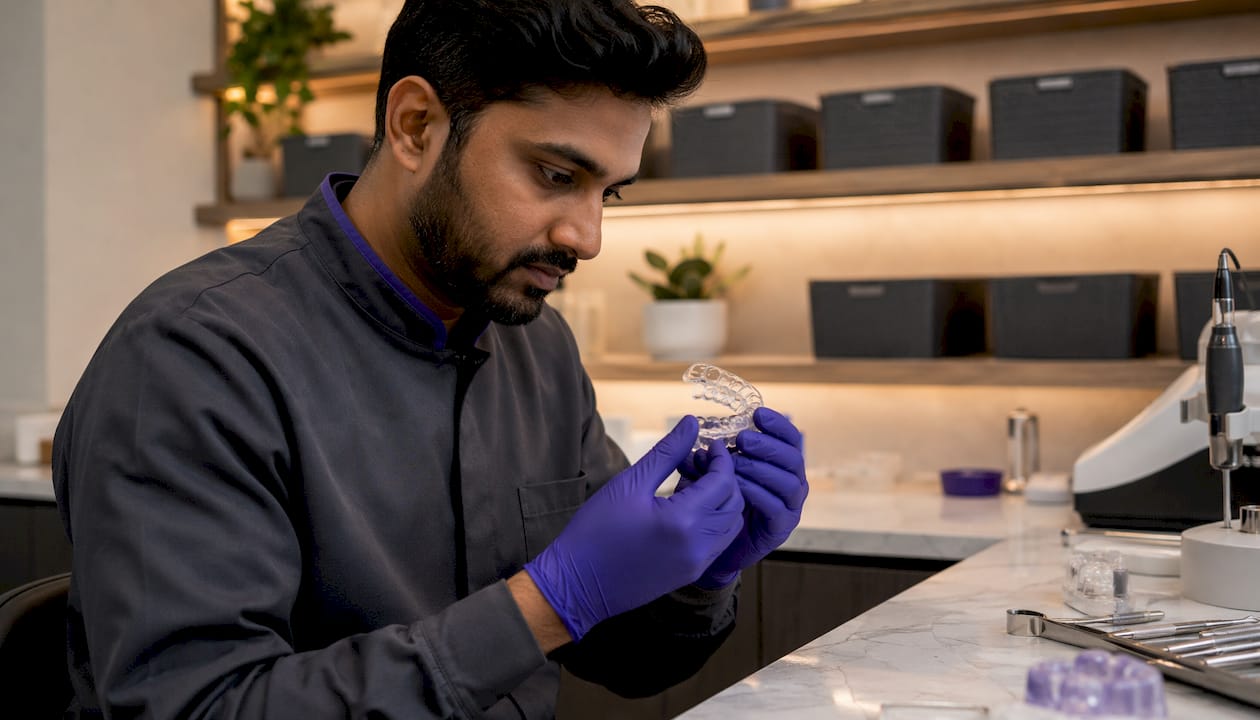
Dual-Laminate (Hard Outer / Soft Inner) These hybrids bond a hard outer shell to a soft inner lining, aiming to combine the muscle-deprogramming effect of a rigid occlusal surface with the comfort of a cushioned fit. They work well for moderate grinders. The catch is delamination risk over time, driven by incompatible polymer chemistry and the thermal cycling that happens every time you put the guard in and take it out. Lifespan typically runs 12–18 months.
Silicone Silicone is chemically stable, generally non-toxic, and latex-free. It’s used in some flexible night guards and is considered safe unless the wearer has a silicone allergy. It doesn’t hold up as well under sustained grinding forces as PMMA, and its surface can become tacky over time, attracting debris.
Standard Thermoplastics (Boil-and-Bite) Over-the-counter boil-and-bite guards use generic thermoplastic materials that soften in hot water and mold loosely to the teeth. They’re inexpensive and accessible, but the fit is imprecise, the material is usually thicker than necessary, and they offer no occlusal stabilization. For anything beyond occasional mild use, a custom-fabricated guard from a dental lab is a meaningfully better choice.
| Material | Rigidity | Occlusal Stabilization | Durability | Biocompatibility Concerns | Typical Cost Band | Cleaning |
|---|---|---|---|---|---|---|
| Soft EVA | Low | Minimal | about a year | BPA/phthalate-free (medical grade) | $ | Gentle soap or enzymatic cleaner |
| Hard PMMA | High | Excellent | 3–5 years | MMA residual (heat-cure minimizes) | $$$ | Non-abrasive cleanser |
| Copolyester | Medium-high | Good | 1–3 years | No known toxicity | $$ | Mild soap |
| Dual-laminate | Medium | Good | 12–18 months | Interface chemistry varies | $$ | Gentle enzymatic |
| Silicone | Low-medium | Minimal | 1–2 years | Safe unless allergy | $$ | Mild soap |
| Boil-and-bite | Low | None | — | Varies by brand | $ | Rinse/brush |
Why material choice changes your clinical outcome
The primary job of a therapeutic mouth guard is occlusal stabilization, not cushioning. That distinction matters clinically because a rigid occlusal surface can “deprogram” the masticatory muscles by giving them a stable, predictable contact point that interrupts the grinding cycle. A soft surface does the opposite: it gives under load, creating proprioceptive confusion that can actually increase muscle activity in some patients.

Clinical guidance is consistent on this point. Hard PMMA appliances are preferred for severe bruxism and TMD because they provide the flat, stable occlusal plane that allows jaw muscles to relax. Soft EVA guards are appropriate for sports (impact absorption is the goal, not muscle deprogramming) and for mild clenchers who can’t tolerate a rigid appliance at first.
One dataset found roughly 54% treatment failure within six months when material selection ignored biomechanical requirements, and a subset of patients using soft guards showed increased clenching activity. Those numbers make a strong case for matching material to severity rather than defaulting to whatever is most comfortable at first try.
Severity-to-material mapping:
- Mild clenching: Soft EVA or copolyester; comfort is the priority; custom fit still matters for retention
- Moderate bruxism: Dual-laminate; provides rigid occlusal contact with a softer seating surface; good diagnostic starting point
- Severe bruxism / TMJ symptoms: Hard PMMA; maximum occlusal stabilization; protects restorations; longest lifespan
- Post-restoration patients: Hard PMMA only; soft materials can flex against crowns and implants in ways that accelerate wear on the restoration margin
For patients who have never worn a guard, a short diagnostic trial with a dual-laminate appliance can help identify tolerance before committing to a full hard acrylic fabrication. The ADA’s CDT coding guidance notes that any appliance with a hard occlusal component is documented as a hard appliance (D9944/D9946), regardless of what the inner lining is made of. That classification reflects the clinical reality: the occlusal surface determines therapeutic effect.
For patients dealing with TMJ or TMD symptoms, the material choice is especially consequential. A soft guard that increases muscle activity can worsen joint loading rather than relieve it.
Are mouth guard materials actually safe?
The short answer: yes, when the guard comes from a reputable lab using medical-grade materials. The longer answer involves understanding which chemical concerns are real and which are overstated.
BPA and phthalates: Modern medical-grade EVA and copolyester are formulated to be BPA-free and phthalate-free. The risk is real only when buying from unknown sources with no material documentation. Reputable labs disclose this on their material spec sheets.
MMA (Methyl Methacrylate): MMA is the monomer used in acrylic fabrication. Residual MMA in a poorly cured cold-process acrylic can cause sensitization reactions. Heat-cured PMMA drives off residual monomer during polymerization, which is why heat-cure processing is the standard for therapeutic appliances. The cured, solid form of PMMA in a properly fabricated guard has a well-established safety record.
Silicone: Chemically stable and generally non-toxic. Safe for most users unless there’s a documented silicone allergy.
Latex: Rarely used in modern dental guards precisely because of allergy risk. If you have a latex sensitivity, confirm with your provider before ordering.
Practical safety checklist when evaluating a vendor:
- Material is explicitly stated as medical-grade or dental-grade
- ISO 10993 biocompatibility testing is referenced or available on request
- MSDS or technical data sheets are available for the specific material used
- Heat-cure processing is specified for hard acrylic appliances (not cold-cure)
- Lab is supervised by licensed dental technicians
- Cleaning and sterilization guidance is provided with the appliance
Pro Tip: Before ordering a custom hard acrylic guard, ask the lab whether they use heat-cure or cold-cure processing. Cold-cure acrylic contains higher residual MMA and is more likely to cause sensitivity reactions. A reputable lab will answer this without hesitation.
Position statements for custom sports mouthguards recommend FDA- and EU-approved materials and note that thermoformed laminated EVA remains the clinical standard for athletic use, with CAD/CAM and 3D printing emerging as alternatives.
How to pick the right material for your situation
Start with your use case, then layer in your clinical history.
Quick self-assessment:
- Sports or contact activity? Go with soft EVA. Cushioning and impact absorption are what matter here, not occlusal stabilization.
- Mild clenching or stress-related jaw tension? Soft EVA or copolyester, custom-fitted. Boil-and-bite is a stopgap, not a solution.
- Moderate grinding (partner hears it, you wake with jaw soreness)? Dual-laminate. Get a custom lab-fabricated version, not an OTC product.
- Severe grinding, TMJ diagnosis, or existing crowns/implants? Hard PMMA, period. Ask your dentist about occlusal thickness (typically 2–3 mm for therapeutic splints).
- Children grinding at night? Material choice follows the same logic, but fit and monitoring matter more given jaw development. A pediatric-specific guide can help parents navigate the options.
Questions to ask your dentist or vendor:
- Is this material medical-grade? What is the specific polymer?
- Is it heat-cured or cold-cured (for acrylic)?
- What is the elastic modulus, and is it appropriate for my force level?
- What is the expected lifespan under heavy grinding?
- Is ISO 10993 biocompatibility testing documentation available?
- What is the occlusal thickness, and how was it determined?
Red flags that should prompt caution:
- Vendor cannot name the specific material or polymer
- No MSDS or material safety documentation available
- Claims of unrealistic lifespans (e.g., “lasts forever” for a soft guard)
- Dual-laminate claims with no information on the bonding method
- No mention of lab technician oversight or quality control
Custom lab-fabricated guards consistently outperform boil-and-bite options on fit, retention, and therapeutic effect. The fabrication method directly affects how well the guard seats, how stable the occlusal contact is, and how long the appliance holds its shape under repeated loading.
Cleaning, storage, and knowing when to replace
How you care for a guard affects both its lifespan and its safety. Bacterial colonization on a worn guard is a real hygiene concern, especially with soft materials.
Cleaning by material:
- Soft EVA: Rinse immediately after use. Clean daily with a gentle enzymatic cleaner or mild soap. Avoid alcohol-based mouthwash, which degrades the surface. Never use hot water, which can warp the shape.
- Hard PMMA: Non-abrasive cleanser or a denture tablet. Avoid harsh solvents (acetone, bleach) that can cloud or crack the surface. A soft-bristle brush works well.
- Dual-laminate: Treat the inner surface like EVA and the outer like PMMA. Enzymatic cleaners are the safest choice for the bond interface.
- Silicone: Mild soap and water. Avoid abrasive brushes that scratch the surface and create sites for bacterial adhesion.
Storage:
Keep guards in a ventilated case away from direct heat and sunlight. Heat above roughly 140°F can deform thermoplastic materials. Never leave a guard on a car dashboard or near a heating vent.
Replacement timeline and wear signals:
| Material | Typical Lifespan | Replace Immediately If… |
|---|---|---|
| Soft EVA | about a year | Visible tears, thinning, persistent odor |
| Dual-laminate | 12–18 months | Delamination, cracking at the interface |
| Hard PMMA | 3–5 years | Deep grooves, fracture lines, poor fit |
| Copolyester | 1–3 years | Warping, loss of occlusal contact |
Soft materials develop surface porosity over time, which increases bacterial adhesion and makes thorough cleaning progressively harder. That’s the primary reason soft guards need more frequent replacement than hard ones, not just wear through grinding.
Why dual-laminate guards are often the practical compromise
Dual-laminate designs have a genuine clinical rationale. The hard outer shell provides the rigid occlusal surface that deprograms masticatory muscles, while the soft inner lining makes initial seating more comfortable and improves retention on the arch. For moderate grinders who can’t tolerate a fully rigid appliance from day one, this combination often produces better compliance than jumping straight to hard acrylic.
The limitation is at the material interface. Bonding chemically dissimilar polymers is inherently difficult, and thermal cycling (the repeated heating and cooling from normal use) stresses that bond over time. Delamination typically starts at the edges, where finishing quality is most variable. A well-made hybrid from a reputable lab uses adhesive protocols designed for the specific polymer pair, applies thermal cycling tests during quality control, and finishes edges cleanly to minimize stress concentration.
Lower-quality hybrids skip those steps. The result looks similar out of the box but starts separating within months. When evaluating a dual-laminate option, ask the lab what adhesive system they use and whether the bond is tested before the appliance ships.
- Dual-laminate makes sense as a diagnostic trial for new patients before committing to full hard acrylic fabrication
- It’s a reasonable long-term choice for moderate grinders with good compliance and regular replacement habits
- For severe bruxism, a monolithic hard PMMA appliance is preferable because there’s no interface to fail
Pro Tip: Ask the lab specifically: “What is your bond method for the hard-soft interface, and what delamination rate do you see at 12 months?” A lab that tracks this data and answers confidently is one that takes manufacturing quality seriously.
Key Takeaways
Hard PMMA is the only material that provides the occlusal stabilization severe bruxism requires; soft EVA suits sports and mild clenching, and dual-laminate fills the moderate-grinding middle ground.
| Point | Details |
|---|---|
| Match material to force level | Soft EVA for sports/mild clenching; dual-laminate for moderate grinding; hard PMMA for severe bruxism or restorations. |
| Hard surfaces deprogram muscles | Rigid occlusal contact interrupts the grinding cycle; soft surfaces can increase masticatory muscle activity in heavy grinders. |
| Verify safety credentials | Confirm medical-grade material, ISO 10993 testing, heat-cure processing for acrylic, and MSDS availability before buying. |
| Plan replacements proactively | Soft guards last about a year; dual-laminate 12–18 months; hard PMMA 3–5 years. Replace at first sign of wear, thinning, or delamination. |
| Clearretain product match | Clearretain’s Sports Mouth Guard, Hard-Soft Night Guard, and Premium Hard Night Guard map directly to the three material tiers above. |
The material question most buyers get wrong
The conventional framing of mouth guard shopping is comfort-first: people try a soft guard because it feels better immediately, and they stick with it until it stops working. That’s understandable, but it’s backwards from a clinical standpoint.
The material decision should start with your force level and therapeutic goal, not your comfort preference. Comfort matters, but it’s a secondary variable. A soft guard that feels great but increases your clenching activity isn’t protecting you. A hard guard that feels unfamiliar for the first week but actually quiets your jaw muscles is doing its job.
The other thing buyers consistently underestimate is fabrication quality. Two guards made from nominally the same material can perform very differently depending on whether they were thermoformed under controlled conditions, heat-cured properly, finished cleanly, and fitted from an accurate impression. The material spec is the starting point. The lab process is what determines whether that spec translates into a guard that actually fits and lasts.
That’s why Clearretain’s approach, FDA-approved materials fabricated under licensed technician supervision, matters more than it might seem from the outside. The material certificate is table stakes. The process behind it is what separates a guard that works from one that doesn’t.
Clearretain’s custom guards match every material tier
Clearretain makes it straightforward to get the right material for your specific situation, without the markup of an in-office fabrication.
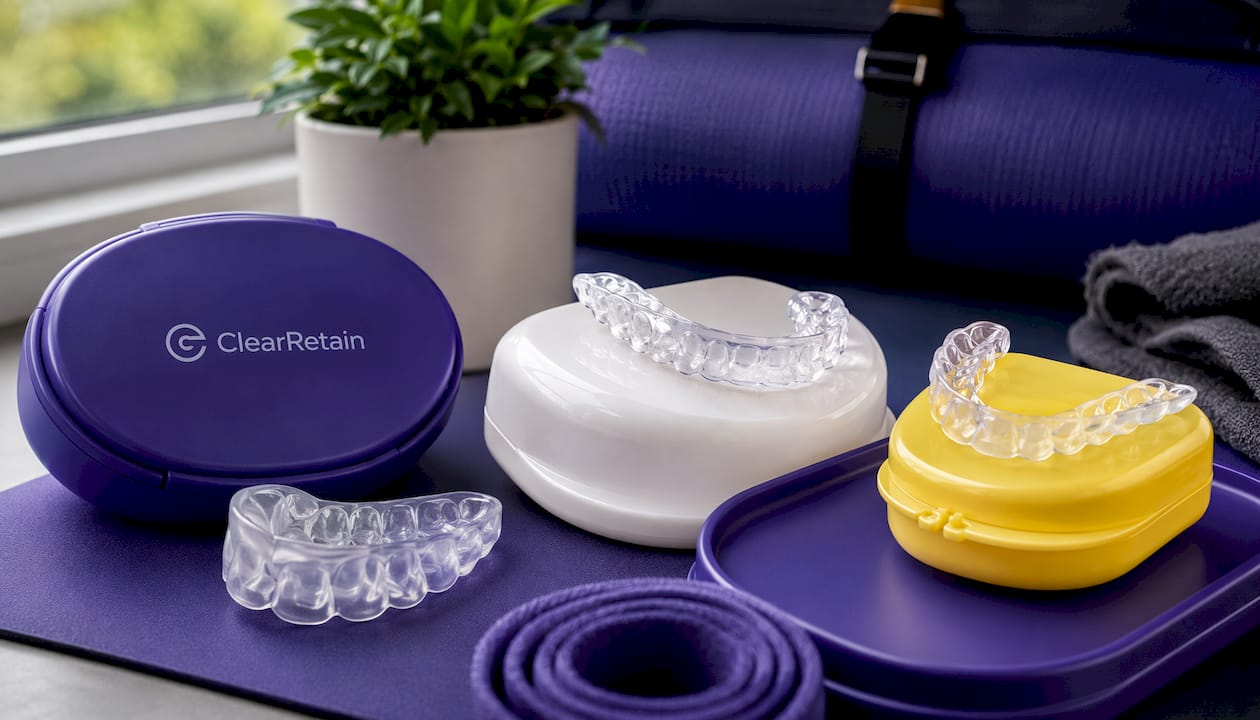
The Sports Mouth Guard (Multiple Colors) uses medical-grade EVA, thermoformed from a custom impression for a precise fit that OTC boil-and-bite guards can’t match. For moderate grinders, the Hard-Soft Night Guard (Dual Layer) delivers the rigid occlusal surface and soft inner comfort that makes compliance easier. Severe grinders and anyone protecting dental restorations should look at the Premium Hard Night Guard, fabricated from heat-cured PMMA under technician oversight with the occlusal thickness needed for long-term therapeutic use.
Every Clearretain guard ships with a self-impression kit, detailed instructions, and is made from FDA-approved materials. Reorders are available using your stored digital impression, so replacement is fast when your guard reaches the end of its lifespan. Prices run up to 80% less than traditional in-office fabrication.
Order your custom guard at clearretain.com and use the material guidance in this article to select the right product for your grinding severity.
This article is general information, not professional dental advice. Confirm material and appliance choices with a licensed dentist for your specific clinical situation.
Useful sources for further reading
-
Position Statement and Recommendations for Custom-Made Sport Mouthguards (PMC/NCBI): Clinical position statement on sports mouthguard materials, fabrication standards, and regulatory expectations. Best for verifying sports-use material recommendations and FDA/EU approval context.
-
ADA CDT Guidance on Occlusal Guards with Hard and Soft Components: Official ADA coding guidance clarifying how combination appliances are documented. Best for understanding how clinicians classify hybrid guards and why the occlusal surface determines therapeutic designation.
-
PubMed: Occlusal Splint Research: Peer-reviewed research on occlusal splint materials and clinical outcomes. Best for verifying claims about occlusal stabilization and bruxism management.
-
PMC: Clinical Materials Research: Research on dental appliance materials and their clinical performance. Best for materials-science verification and biocompatibility context.
-
Health Works Collective: Night Guard Material Safety: Consumer-facing overview of chemical concerns (BPA, phthalates, MMA, silicone, latex) in dental appliances. Best for understanding what to look for on material spec sheets and what questions to ask a provider.