



Retainer vs Aligner: What's the Real Difference?
A dental aligner is an active orthodontic device designed to gradually shift teeth into new positions, while a retainer is a passive appliance that holds teeth in place after treatment ends. Understanding the difference between retainer and aligner is not just a terminology question. It determines which device you need, when you need it, and what happens to your teeth if you skip it. Both appliances are clear, removable trays that fit over your teeth. They look nearly identical. But confusing one for the other is one of the most common mistakes people make after completing orthodontic treatment.
What is a dental aligner and how does it move teeth?
Aligners are active orthodontic devices used during treatment to gradually move teeth through controlled, sequential pressure. Each tray is slightly different from the last. Wearing each tray for one to two weeks nudges teeth a fraction of a millimeter closer to their target position. The cumulative effect across dozens of trays produces the final result.
Invisalign is the most recognized brand in this category. Invisalign uses clear thermoplastic trays engineered to apply force at specific points on specific teeth. Other aligner systems follow the same principle: a series of custom trays, each representing a planned stage of tooth movement.
Aligners handle complex movements. These include arch expansion, incisor proclination (tipping front teeth forward), and rotation of individual teeth. Each of these movements requires precise force vectors built into the tray geometry. A single aligner tray cannot accomplish the full correction. The sequence of trays is what drives the result.
- Wear time: 20–22 hours per day for effective tooth movement
- Replacement schedule: Every 1–2 weeks as teeth shift into each new position
- Treatment length: Varies by case complexity, typically several months to a few years
- Attachments: Small tooth-colored bumps bonded to teeth to help aligners grip and apply targeted force
Pro Tip: Never skip a tray or jump ahead in your aligner sequence. Each tray is calibrated for the position your teeth should be in at that exact stage. Skipping creates gaps in the force plan and can stall or reverse progress.
What is a dental retainer and what does it actually do?
A retainer is a passive appliance. It does not move teeth. Its only job is to hold teeth in the position they reached at the end of active treatment. Retainers hold teeth to prevent relapse, which is the natural tendency of teeth to drift back toward their original positions.
Teeth are not anchored rigidly in bone. They sit in a periodontal ligament, a flexible tissue that stretches and compresses as teeth move. After orthodontic treatment, that ligament retains a kind of “memory” of the old position. Without a retainer, teeth will shift. This is not a rare complication. It is the default outcome when retention is skipped.
Retainers come in two main forms. Understanding the types of dental retainers helps you choose the right one for your lifestyle and compliance habits.
- Fixed retainers: A thin wire bonded to the back of the teeth, usually the lower front six. They provide continuous retention without requiring any patient action. The tradeoff is that flossing requires a threader, and the wire can collect plaque if not cleaned carefully.
- Removable retainers: Clear thermoplastic trays (similar in appearance to aligners) or Hawley retainers (an acrylic plate with a wire). Removable retainers allow normal brushing and flossing but depend entirely on the patient wearing them consistently.
Fixed vs removable retainers each carry distinct tradeoffs for compliance and hygiene. Fixed retainers offer compliance-free stabilization. Removable retainers require daily discipline but allow better cleaning. Many orthodontists recommend both: a fixed wire behind the lower front teeth plus a removable clear tray for the upper arch.
Pro Tip: If you know you will struggle to wear a removable retainer every night, tell your orthodontist before treatment ends. A fixed retainer behind your lower teeth removes the compliance variable entirely for that arch.
How do retainers and aligners differ in design and wear?
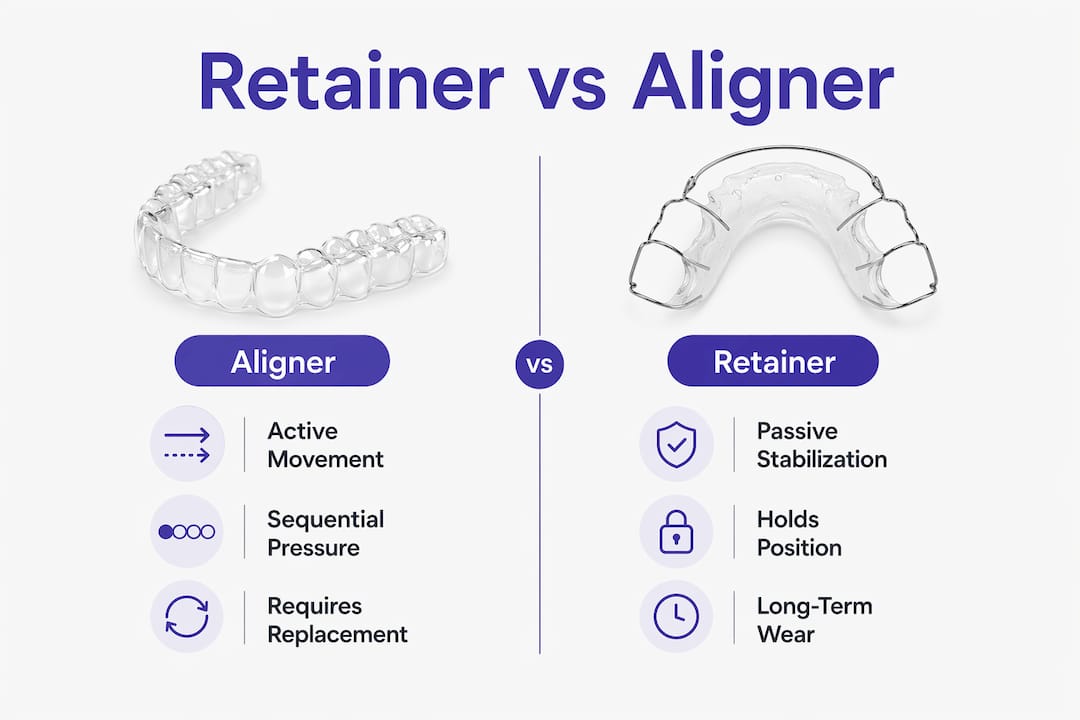
The core functional difference is straightforward. Aligners move teeth; retainers stabilize them. That single distinction drives every other difference in how they are designed, worn, and replaced.
| Feature | Aligner | Retainer |
|---|---|---|
| Primary function | Actively moves teeth | Holds teeth in place |
| Wear duration per tray | 1–2 weeks | Months to years (or indefinitely) |
| Wear schedule | 20–22 hours/day during treatment | Full-time initially, then nighttime only |
| Replacement frequency | Frequent, per treatment plan | Only when damaged or no longer fitting |
| Can straighten teeth? | Yes | No |
| Used after treatment? | No | Yes |
A common misconception is that a clear retainer can substitute for an aligner if teeth have shifted slightly. It cannot. Retainers cannot replace aligners for active tooth movement. A retainer tray is not calibrated to apply directional force. Wearing an old aligner as a retainer is equally problematic. An aligner tray is designed for a specific stage of movement, not for long-term static wear.
Maintenance also differs. Aligners need frequent replacement every one to two weeks as part of the treatment plan. Retainers last much longer but must be replaced when they crack, warp, or no longer fit snugly. A loose retainer is not protecting your teeth. Checking the fit every few months is a practical habit worth building.
For a detailed cost breakdown on replacement retainers, the Invisalign retainer cost guide from Clearretain covers what patients typically pay and where savings are available.
Why does retainer compliance matter so much after aligner treatment?
Retainer adherence is directly linked to stability outcomes. A 2026 retrospective cohort study published in BMC Oral Health found that full-time retainer wear reduces relapse risk significantly more than irregular wear, with an odds ratio of 0.070 for full-time wear. An odds ratio that low means full-time wearers had dramatically better stability than those who wore retainers inconsistently. The data is not subtle.
The standard protocol after Invisalign treatment is to wear retainers full-time for approximately three months, then transition to nighttime-only wear indefinitely. The three-month full-time phase allows the periodontal ligament to stabilize around the new tooth positions. Skipping this phase and going straight to nighttime wear increases relapse risk.
Here is a practical retention timeline most orthodontists follow:
- Months 1–3 after treatment: Wear retainers 20–22 hours per day. Remove only to eat and brush.
- Month 4 onward: Transition to nighttime retainer use, wearing the retainer every night while sleeping.
- Ongoing: Continue nightly wear indefinitely. Teeth do not reach a permanent stable state. Ongoing forces from chewing, speaking, and natural aging mean relapse risk never fully disappears.
- Replacement: Replace retainers when they show visible wear, cracking, or no longer seat fully on the teeth.
Retention should be planned from the start of treatment, not treated as an afterthought at the end. Orthodontists who build retention into the treatment plan from day one set better expectations and see better long-term outcomes. Patients who understand why retention matters are more likely to follow through.
For patients at higher relapse risk, combining fixed and removable retainers may provide better stability than either type alone. A bonded wire handles the lower front teeth around the clock, while a removable clear tray covers the upper arch each night. This dual approach addresses both compliance gaps and anatomical relapse risk.
Key Takeaways
Retainers and aligners serve opposite roles: aligners create tooth movement during treatment, and retainers prevent movement after treatment ends.
| Point | Details |
|---|---|
| Aligners are active devices | They apply sequential pressure to move teeth and are replaced every 1–2 weeks. |
| Retainers are passive devices | They hold teeth in place after treatment and cannot straighten misaligned teeth. |
| Full-time wear reduces relapse | A 2026 study found full-time retainer wear dramatically lowers relapse risk versus irregular wear. |
| Retention is a lifelong commitment | After an initial full-time phase, nightly wear should continue indefinitely. |
| Fixed and removable options exist | Choosing between them depends on your compliance habits and relapse risk. |
What I’ve learned from watching patients skip the retainer step
The most common regret I hear from people who completed aligner treatment is not about the treatment itself. It is about what happened after. They finished their last tray, loved their results, and then wore their retainer inconsistently for a few months. A year later, they noticed their teeth had shifted. By then, a retainer alone could not fix it.
The uncomfortable truth is that orthodontic treatment does not end when the aligners come out. The retention phase is not a formality. Teeth are biological structures embedded in living tissue, and that tissue has a long memory. Teeth naturally tend to relapse over decades, and no treatment fully eliminates that tendency.
My practical advice: choose your retainer type based on your actual behavior, not your ideal behavior. If you know you will forget to put in a removable retainer, a fixed wire behind your lower teeth removes that variable. If you travel frequently or have a demanding schedule, a removable retainer that fits your routine is better than a perfect protocol you will not follow.
Treat the retention phase with the same seriousness you gave the treatment phase. The investment you made in straightening your teeth is only protected if you wear your retainer.
— Clear
Protect your results with Clearretain
You spent months in aligners to get your teeth where they are. A well-fitted retainer is what keeps them there.
Clearretain offers clear upper retainers, clear lower retainers, and a combined upper and lower retainer set designed specifically for post-aligner retention. All retainers are made from FDA-approved materials under the supervision of experienced orthodontic technicians. Orders ship directly to you with a detailed self-impression kit, cutting out the office visit markup entirely. Customers report savings of up to 80% compared to standard orthodontic pricing. Your results deserve protection that fits your budget.
FAQ
What is the main difference between a retainer and an aligner?
An aligner actively moves teeth through sequential controlled pressure during orthodontic treatment. A retainer passively holds teeth in their final position after treatment ends and cannot produce tooth movement.
Can I use my old aligners as retainers?
No. Aligners are calibrated for a specific stage of tooth movement, not for long-term static wear. Using an old aligner as a retainer can apply unintended pressure and may cause unwanted movement.
How long do I need to wear a retainer after aligner treatment?
Wear your retainer full-time for approximately three months after treatment, then transition to nightly wear indefinitely. Relapse risk persists long-term, so nightly wear should continue for life.
What happens if I stop wearing my retainer?
Teeth will gradually shift back toward their original positions. This process can begin within weeks of stopping retainer wear and becomes harder to reverse the longer it continues.
Which is better: a fixed retainer or a removable one?
Neither is universally better. Fixed retainers offer compliance-free retention but require careful hygiene. Removable retainers allow easier cleaning but depend on consistent daily wear. Many orthodontists recommend using both for maximum stability.