



Invisalign Retainer Cost: What You'll Actually Pay
Invisalign retainer cost typically ranges from $100 to over $1,000 depending on the retainer type, your provider, and whether you need a replacement set. The official Invisalign retainer line is called Vivera, and Vivera retainers cost $400 to over $1,000 for a set of four. That wide range surprises most patients who assume retainers are a minor expense after completing treatment. Understanding what drives those numbers helps you plan ahead and avoid paying more than necessary.
How much does an invisalign retainer cost?
The price you pay for an Invisalign retainer depends on three main factors: the type of retainer, your provider’s fees, and your location. Vivera retainers are made by Align Technology, the same company behind Invisalign aligners. They are custom-fit clear retainers sold in sets of four, which means you get backup pairs built into the purchase.
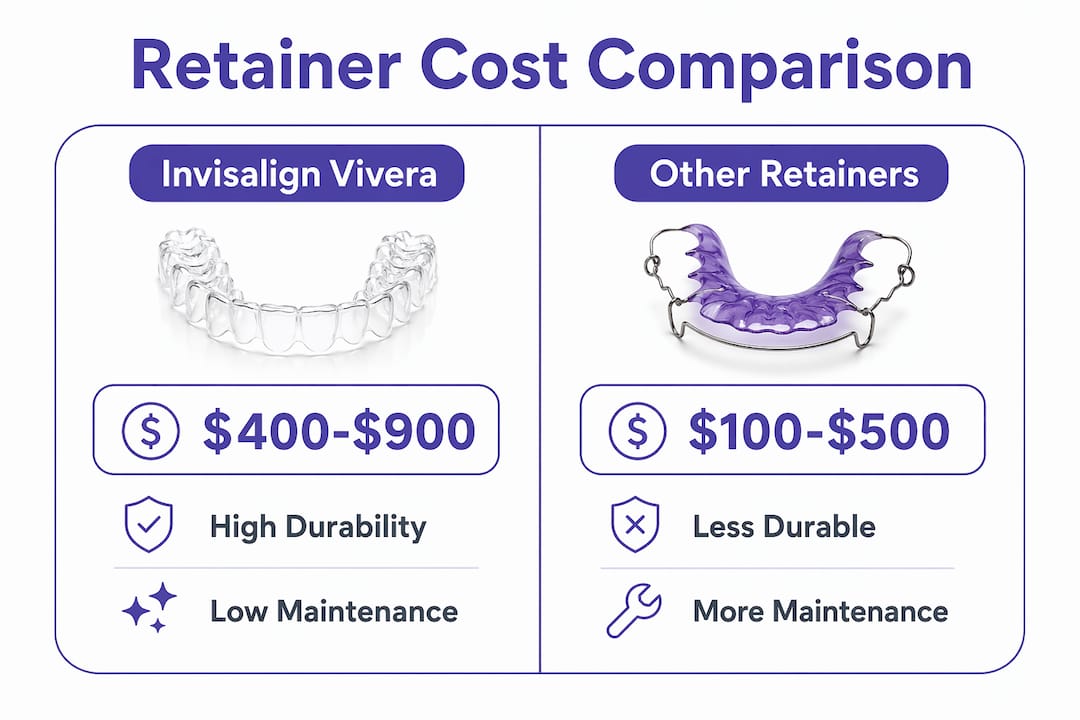
Removable retainers cost about $100–$500 per arch for standard Essix-style clear retainers, while Vivera sets run $400–$900 for four retainers. Permanent bonded retainers cost $250–$600 per arch and require professional installation. That means a full set of Vivera retainers covering both arches can approach or exceed $1,000 at some orthodontic offices.
Geographic location matters more than most patients expect. An orthodontist in Manhattan or San Francisco will charge significantly more for the same Vivera set than a provider in a mid-size Midwestern city. The provider’s overhead, the technology they use for digital scans, and any consultation fees all get folded into the final price.
Pro Tip: Ask your orthodontist at the start of treatment whether retainer costs are included in your total Invisalign fee. Many providers bundle the first set of Vivera retainers into the treatment price, which saves you $400 or more upfront.
What factors influence invisalign retainer prices?
Several specific variables push the cost of Invisalign retainers up or down. Knowing each one helps you ask the right questions before you commit.
- Retainer type. Vivera retainers are thicker and more durable than standard Essix retainers. That durability comes at a higher price point. Permanent bonded wire retainers cost less per unit but require professional maintenance and specialized flossing tools that add to long-term expenses.
- Provider fees. Orthodontists set their own pricing. Some charge a flat fee for a four-pack of Vivera retainers. Others charge per arch, per set, or add a separate fee for the digital scan needed to fabricate them.
- New impressions or scans. If your teeth have shifted since treatment ended, your orthodontist may need to take new digital scans before ordering replacement retainers. That scan appointment adds cost and time to the process.
- Insurance coverage. Dental insurance coverage for orthodontic retainers varies widely. Some plans cover a portion of replacement retainers; many cover nothing after the initial set. Verifying your benefits before ordering prevents billing surprises.
- Replacement frequency. Heavier use leads to faster wear, and some full-time wearers replace retainers every three months. That replacement cycle multiplies your annual retainer cost significantly if you are not budgeting for it.
How much do replacement invisalign retainers cost?
Replacement retainer costs are one of the most overlooked expenses in orthodontic care. Most patients budget for treatment but not for the years of maintenance that follow.
Here is what to expect when you need to replace your Vivera or clear retainers:
- Standard Vivera replacement set. A four-pack of Vivera retainers from your orthodontist typically costs $400–$900. That price usually covers both upper and lower retainers across the four sets.
- Single arch replacement. If you only need an upper or lower retainer replaced, some providers will sell individual arches. Expect to pay $100–$300 per arch depending on the retainer type and provider.
- New scan fee. If your teeth have shifted, new scans may be needed before fabricating replacement retainers. This adds a separate appointment cost, often $50–$150, on top of the retainer price.
- Emergency replacement. Losing or breaking a retainer without a backup means paying for an expedited order and possibly an unplanned office visit. Emergency replacements often cost more than planned reorders.
- Relapse treatment. Skipping retainer replacement entirely and allowing teeth to shift back can require a new round of orthodontic treatment. That cost runs into the thousands. Proactive replacement is always cheaper.
Vivera retainers come in sets of four, which means ordering a complete set gives you built-in backups. Keeping a spare set at home protects you from gaps in retention if one retainer is lost or damaged.
Pro Tip: Order your next set of retainers before your current ones show signs of failure. Loose fit, visible cracks, and persistent odor are early warning signs of wear that signal it is time to reorder, not wait.
Invisalign vivera vs. other retainer types: a cost comparison
Choosing the right retainer type is partly a cost decision and partly a lifestyle decision. The table below breaks down the key differences.
| Retainer Type | Cost Per Arch | Full Set Cost | Durability | Maintenance |
|---|---|---|---|---|
| Vivera (Invisalign) | $200–$450 | $400–$900 (4-pack) | High | Low |
| Essix (standard clear) | $100–$250 | $200–$500 | Moderate | Low |
| Permanent bonded wire | $250–$600 | $500–$1,200 | Very high | High |
Vivera retainers are made from a proprietary plastic that Align Technology claims is 30% stronger than other clear retainer materials. That durability means they last longer between replacements, which can offset the higher upfront cost over time.
Essix retainers are the most common alternative. They are less expensive per set but tend to wear out faster, especially for patients who grind their teeth at night. Replacing a cheaper Essix retainer every six months can cost more annually than replacing a Vivera set once a year.
Permanent wire retainers require routine maintenance such as rebonding and specialized flossing techniques that add to overall cost and effort. They are effective for long-term retention but demand more from patients in terms of daily oral hygiene.
How do you order or reorder invisalign retainers?
The reordering process is straightforward when your teeth have not shifted. Here is what to expect:
- Contact your original orthodontist first. They hold your digital scan files and can reorder Vivera retainers directly through Align Technology. This is the fastest and most accurate route.
- Confirm your digital records are on file. Most modern orthodontic offices store digital impressions from your treatment. Stored digital scans simplify reordering and eliminate the need for new physical impressions in most cases.
- Schedule a check if your fit feels off. If your current retainer feels loose or tight, do not reorder from old scans. Your teeth may have shifted, and a new scan will produce a retainer that actually fits.
- Ask about turnaround time. Vivera retainers are fabricated by Align Technology and typically take one to two weeks to arrive after the order is placed. Plan ahead so you are not without a retainer during that window.
- Explore direct-to-consumer options. Services like Clearretain allow you to reorder a premium upper and lower set using your stored digital files, often at a lower price than going back through an orthodontic office.
Financial tips for managing invisalign retainer expenses
Retainer costs are predictable if you plan for them. These strategies help keep expenses manageable over the long term.
- Use your FSA or HSA. Retainers qualify as a medical expense under IRS guidelines. Paying with a Flexible Spending Account or Health Savings Account means you use pre-tax dollars, which reduces your effective out-of-pocket cost by 20–30% depending on your tax bracket.
- Verify insurance benefits before ordering. Insurance coverage varies widely, and some plans cover replacement retainers under orthodontic benefits. A five-minute call to your insurer before ordering can save you hundreds.
- Ask about payment plans. Many orthodontic offices offer in-house payment plans for retainer sets. CareCredit, a healthcare financing card, is also widely accepted and offers promotional interest-free periods.
- Buy in bulk when possible. Ordering a full four-pack of Vivera retainers costs less per retainer than ordering individual replacements. The backup sets also protect you from gaps in retention.
- Negotiate at treatment start. Ask your orthodontist to include the first two years of retainer replacements in your total treatment fee. Many providers will agree, especially for patients paying in full upfront.
Pro Tip: Retention is a lifelong commitment requiring cooperation between you and your provider. Build a recurring annual budget line for retainer replacement the same way you budget for dental cleanings. It is far cheaper than re-treatment.
Key takeaways
Invisalign retainer cost ranges from $100 to over $1,000 depending on retainer type, provider fees, and whether replacement sets are needed.
| Point | Details |
|---|---|
| Vivera retainer pricing | Expect $400–$900 for a four-pack covering both arches from most orthodontists. |
| Replacement budgeting | Plan for annual retainer replacement costs to avoid expensive relapse treatment. |
| Type comparison | Vivera outlasts standard Essix retainers, often making it cheaper over a multi-year period. |
| Insurance and FSA | Verify coverage before ordering and use FSA or HSA funds to reduce out-of-pocket costs. |
| Reorder process | Stored digital scans make reordering fast; new scans are needed only if teeth have shifted. |
What i’ve learned about retainer costs after orthodontic treatment
The biggest financial mistake I see patients make is treating retainers as a one-time purchase. They complete Invisalign treatment, receive their first set of Vivera retainers, and assume the expense is done. It is not. Retention is a medically necessary, ongoing phase that requires consistent attention and regular replacement.
The patients who end up spending the most are the ones who wait too long to replace worn retainers and allow their teeth to shift. A $600 Vivera set feels expensive until you compare it to a $4,000 retreatment. Proactive replacement is not optional maintenance. It is the most cost-effective decision you can make after orthodontic treatment.
My honest advice: monitor your retainer fit every month. If it feels even slightly loose, that is your signal to act. Do not wait for a visible crack or a broken piece. Retainer failure often begins as loss of fit before any visible damage appears. Catching it early keeps you out of the dental chair and out of an expensive emergency situation. Talk openly with your provider about costs. Most orthodontists will work with you on pricing, especially if you are a returning patient reordering through their office.
— Clear
Affordable retainer options from Clearretain
If the cost of replacing Invisalign retainers through your orthodontist feels steep, Clearretain offers a direct-to-consumer alternative that cuts out the office markup. Clearretain provides FDA-approved, custom clear retainers made under the supervision of experienced orthodontic technicians, at a fraction of traditional practice prices.

You can order a custom upper and lower retainer set directly online, or shop individual upper retainers and lower retainers depending on what you need. The process uses a detailed self-impression kit, so you get a precise fit without a separate office visit. Customers report savings of up to 80% compared to standard orthodontic pricing. Visit Clearretain to review current pricing and find the right retainer option for your post-Invisalign care.
FAQ
How much does an invisalign retainer cost on average?
Invisalign Vivera retainers typically cost $400–$900 for a set of four, covering both upper and lower arches. Standard clear retainers cost $100–$500 per arch depending on the provider.
How much does it cost to replace an invisalign retainer?
Replacement Invisalign retainers cost $400–$900 for a Vivera four-pack, or $100–$300 per arch for a single replacement. New scan fees may apply if your teeth have shifted since your last set was made.
Does dental insurance cover invisalign retainer replacement?
Coverage varies by plan. Some dental insurance policies cover a portion of replacement retainers under orthodontic benefits, but many do not. Always verify your benefits before ordering to avoid unexpected out-of-pocket costs.
How often do invisalign retainers need to be replaced?
Replacement frequency depends on wear habits. Some full-time wearers replace retainers every three months, while others go one to two years between replacements. Signs like loose fit, cracks, or odor signal it is time to reorder.
Can i reorder invisalign retainers without visiting my orthodontist?
Yes, in many cases. If your orthodontist has your digital scans on file, they can reorder Vivera retainers without a new appointment. Direct-to-consumer services like Clearretain also allow reordering using stored digital files or a new self-impression kit.