


Why Teeth Shift After Braces: What You Need to Know
Teeth shifting after braces, known clinically as orthodontic relapse, is a natural biological process driven by elastic memory in the periodontal ligaments surrounding your teeth. These ligaments act like stretched rubber bands after treatment ends, slowly pulling teeth back toward their original positions. Aging, jaw growth, and daily oral pressures compound this effect over time. The good news is that relapse is predictable and largely preventable. Understanding why it happens is the first step toward keeping your smile aligned for life.
Why teeth shift after braces: the biology behind relapse
Orthodontic relapse begins the moment your braces come off. The supracrestal gingival fibers act like microscopic rubber bands stretched during tooth movement, slowly recoiling after braces removal. These fibers sit just above the bone and take far longer to reorganize than the bone itself. That mismatch is the core reason teeth move back.
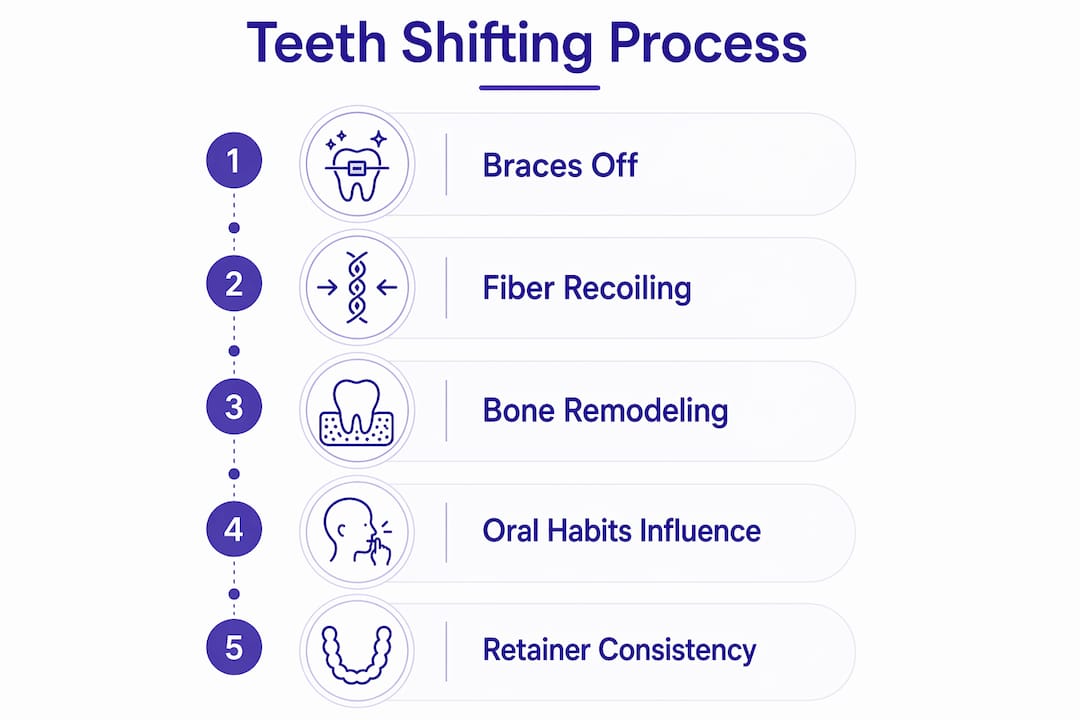
Bone remodeling and fiber reorganization happen on different timelines. The first 12–18 months post-braces carry the highest risk of movement because fiber reorganization lags significantly behind faster bone adaptation. This is why orthodontists push the hardest on retainer wear during that initial window.
Age adds another layer of complexity. Long-term studies show clinically significant relapse 5 to 20 years post-treatment, driven by aging bone and craniofacial changes. Mandibular late-stage crowding, the natural tendency for lower front teeth to crowd inward, increases with age regardless of whether you ever had braces. Adults in their thirties and beyond often notice this as a gradual tightening or overlapping of the lower front teeth.
Several biological factors accelerate the process:
- Periodontal ligament memory: Fibers stretched during treatment pull teeth back toward pre-treatment positions.
- Bone density changes: Aging reduces bone density, making teeth less anchored over time.
- Craniofacial growth: The jaw continues subtle growth into early adulthood, shifting tooth positions.
- Occlusal forces: Lip, cheek, and tongue forces continue acting on teeth, causing slow drift even after long-term correction.
- Pretreatment severity: Greater dentoalveolar compensations strain periodontal and muscular tissues, increasing the likelihood of post-treatment shifting.
Pro Tip: Ask your orthodontist about your pretreatment crowding severity. Patients with larger initial displacements face a higher relapse risk and may benefit from more aggressive retention schedules.
How oral habits and lifestyle affect post-braces stability
Biology is not the only force working against your alignment. Daily habits create constant, low-grade pressure on your teeth. Over months and years, that pressure adds up.

Unconscious forces from tongue resting position, mouth breathing, and nail biting exert sufficient pressure over time to shift teeth and can undermine orthodontic treatment success. Tongue thrusting, where the tongue pushes forward against the front teeth during swallowing, is a particularly common culprit. Most people swallow hundreds of times a day, so even a slight forward push accumulates into real tooth movement.
Bruxism, the clinical term for teeth grinding, poses a separate threat. Patients with severe bruxism can traumatize periodontal ligaments and cause teeth to tilt or shift, worsening alignment after braces. Grinding typically happens at night, making it easy to overlook until the damage shows up in your bite or on worn enamel.
Common habits that contribute to teeth shifting include:
- Tongue thrusting: Forward pressure on front teeth during swallowing.
- Mouth breathing: Alters the natural balance of tongue and lip pressure on teeth.
- Nail biting or pen chewing: Applies uneven lateral force to specific teeth.
- Chronic clenching: Compresses periodontal ligaments and can tilt teeth over time.
Pro Tip: If you wake up with jaw soreness or headaches, you may be grinding at night. A protective night guard protects both your enamel and your orthodontic results simultaneously.
What role do retainers play in preventing teeth from shifting?
Retainers are the single most effective tool for preventing orthodontic relapse. They hold teeth in position while the periodontal fibers reorganize and the surrounding bone fully stabilizes. Without a retainer, those fibers pull teeth back within weeks.
The retention protocol follows two phases:
- Full-time wear (first 6–12 months): Wear your retainer day and night, removing it only to eat and brush. This phase covers the highest-risk window when fiber reorganization is slowest.
- Nighttime wear (lifelong): The American Association of Orthodontists recommends lifelong retainer wear to prevent biological relapse. Nightly wear keeps teeth stable against the ongoing forces of aging, muscle pressure, and jaw changes.
Skipping retainer wear, even for a few weeks, can allow noticeable movement. Many people discover this the hard way when a retainer that once fit perfectly suddenly feels tight or will not seat fully. A tight retainer is an early warning sign of relapse. Prompt action at that stage can prevent more costly retreatment later.
Signs your retainer needs attention:
- It feels noticeably tighter than usual after a short break.
- It no longer seats fully without pressure.
- You see visible cracks, warping, or discoloration in the material.
- Your teeth look or feel different from when treatment ended.
Knowing when to replace your retainer is as important as wearing it consistently. A warped or cracked retainer provides no protection and can even apply uneven pressure that worsens alignment. Replace it immediately rather than waiting for your next dental appointment.
Understanding why nighttime retainer use is the long-term standard helps build the habit. Teeth face the least muscular resistance during sleep, making nighttime the ideal window for a retainer to hold position without competing against chewing or speaking forces.
Can teeth shifting after braces be corrected once it occurs?
Minor relapse can almost always be corrected without full retreatment. The key variable is how quickly you act. Early intervention restores alignment before extensive retreatment is needed, reducing both cost and treatment time significantly.
Options for correcting relapse depend on severity:
- Retainer adjustment: For very minor shifts caught early, a new or adjusted retainer may guide teeth back into position.
- Short-term clear aligner therapy: A brief course of clear aligners can address moderate relapse efficiently, often in a matter of months rather than years.
- Fixed appliances: More significant relapse may require a partial course of traditional braces, though this is less common when relapse is caught early.
The financial argument for prevention is straightforward. Replacing a retainer costs a fraction of what a second round of orthodontic treatment costs. Catching a tight retainer early and acting on it is one of the most cost-effective decisions a post-braces patient can make.
Pro Tip: If your retainer feels tight after even a short break, wear it consistently for a week before concluding it no longer fits. Mild tightness sometimes resolves with regular wear. If it still will not seat properly after a week, get a replacement.
Key Takeaways
Orthodontic relapse is a biological certainty, not a treatment failure. Lifelong retainer wear is the most effective defense against teeth shifting after braces.
| Point | Details |
|---|---|
| Relapse starts immediately | Periodontal fibers begin recoiling the moment braces are removed, making early retention critical. |
| First 12–18 months are highest risk | Fiber reorganization lags behind bone remodeling, requiring full-time retainer wear in this window. |
| Habits accelerate shifting | Tongue thrusting, bruxism, and mouth breathing apply constant pressure that compounds biological relapse. |
| Lifelong nighttime wear is standard | The American Association of Orthodontists recommends wearing a retainer every night indefinitely. |
| Early correction is far cheaper | Minor relapse caught quickly can often be fixed with a new retainer or short aligner course. |
The uncomfortable truth about orthodontic retention
Most people finish braces expecting the work to be done. The braces come off, the smile looks great, and the assumption is that it stays that way. That assumption is the most common reason people end up back in an orthodontist’s chair years later.
Orthodontic relapse is not a sign that your treatment failed or that your orthodontist made a mistake. It is a biological certainty. The tissues in your mouth have memory. They were shaped over years before treatment, and they will try to return to that shape unless you actively prevent it. That is not a flaw in the system. It is just how human biology works.
What I have seen consistently is that the patients who maintain their results long term are not the ones with the easiest cases. They are the ones who treat retainer wear as a permanent habit rather than a temporary inconvenience. They put their retainer in every night the same way they brush their teeth. It becomes automatic.
The patients who struggle are usually the ones who stop wearing their retainer after a year or two because everything looks fine. Everything looks fine right up until it does not. By the time they notice the shift, correction requires more time and money than consistent retainer wear ever would have.
Minor ongoing shifts are normal and manageable. The goal is not a perfectly frozen smile. The goal is a stable, healthy bite that holds its general shape over decades. A retainer worn nightly makes that entirely achievable.
— Clear
Protect your results with Clearretain
Finishing orthodontic treatment is a real achievement. Keeping those results requires one simple, consistent habit: wearing a quality retainer every night.
Clearretain offers a premium upper and lower retainer set made from FDA-approved materials under the supervision of experienced orthodontic technicians. The process is direct-to-consumer, which means no office visit markups and no waiting weeks for an appointment. You order online, complete a self-impression kit at home, and receive a retainer built to hold your alignment. Clearretain retainers are designed for long-term nightly wear, with the durability and comfort that makes the habit easy to maintain. For patients who also grind at night, Clearretain’s night guard options protect both enamel and orthodontic results at the same time.
FAQ
Why do teeth shift after braces are removed?
Teeth shift after braces because the periodontal ligaments surrounding them have elastic memory and slowly recoil toward pre-treatment positions. Ongoing muscle pressure from the lips, cheeks, and tongue compounds this movement over time.
How fast do teeth shift without a retainer?
Noticeable movement can begin within weeks of stopping retainer wear, particularly in the first 12–18 months after braces removal when the risk of relapse is highest.
What are the signs of teeth shifting without a retainer?
A retainer that feels tighter than usual, visible crowding or spacing changes, and a bite that feels different are the most common signs that teeth have shifted.
Can shifted teeth go back to normal without braces?
Minor relapse caught early can often be corrected with a new or adjusted retainer or a short course of clear aligners, without requiring a full round of braces.
How long should you wear a retainer after braces?
The American Association of Orthodontists recommends lifelong nightly retainer wear to prevent biological relapse, since the forces driving tooth movement never fully stop.