

Whitening Sensitivity: Dentist Backed Fixes for Sensitive Teeth
Yes, teeth whitening commonly causes temporary sensitivity, but you can usually prevent or manage it with the right steps. The two moves that matter most: pause or space out treatments the moment sensitivity shows up, and start using a desensitizing toothpaste or gel right away. If you have fillings, crowns, receding gums, or pain that feels severe, talk to a dentist about a pre-treatment desensitizer before you whiten again.
TL;DR:
- Using lower peroxide concentrations and spacing out bleaching sessions can significantly reduce the risk and severity of sensitivity.
- Pre-treating teeth with desensitizing toothpaste for one to two weeks and applying pre-application gels lowers post-treatment discomfort.
- Custom-fit trays with controlled gel volume minimize gel leakage and irritation to gums, which helps prevent sensitivity episodes.
- Moderate in-office treatments (25-35%) typically cause less sensitivity than high-concentration procedures, especially when avoiding light activation.
- Persistent or severe pain beyond a few days, especially with swelling or nighttime discomfort, warrants immediate consultation with a dentist.
Table of Contents
- How common is whitening sensitivity, and how long does it last?
- Why does whitening hurt in the first place?
- What can you do before, during, and after whitening to limit pain?
- What does the clinical research say about desensitizing agents?
- Do lower-concentration or in-office treatments hurt less?
- What relieves whitening pain right away?
- When does sensitivity mean you should stop and call a dentist?
- How do you safely restart whitening after sensitivity settles down?
- Whitening is not a gamble if you respect the evidence
- Get whitening results without gambling on sensitivity
- Where this article’s claims come from
- Sources
How common is whitening sensitivity, and how long does it last?
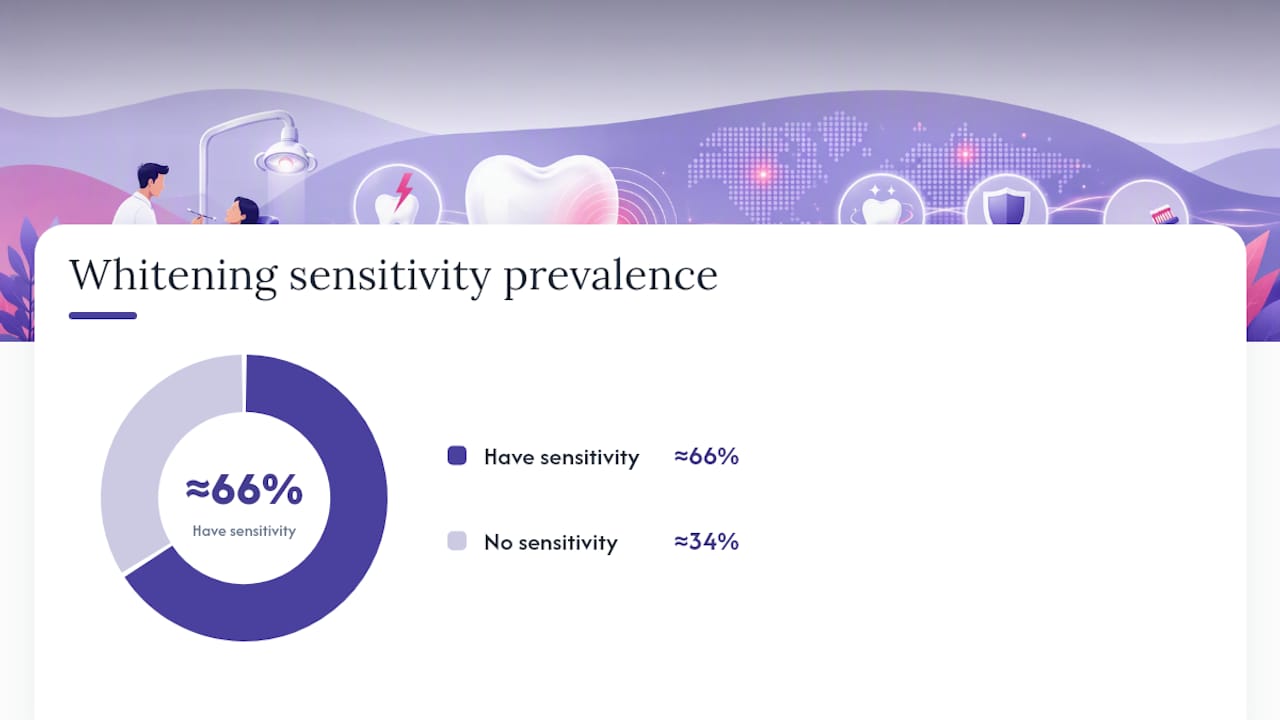
Sensitivity is the rule, not the exception. Transient, mild to moderate sensitivity shows up in up to about two thirds of people during the early stages of bleaching, according to the American Dental Association. Most people are not dealing with a rare side effect. They’re dealing with the normal cost of moving peroxide through enamel.
The timeline follows a fairly predictable arc. With tray-based systems, discomfort tends to start within two to three days of beginning treatment, then eases off around day three or four once you stop or slow down. In-office procedures using stronger gels can trigger sensitivity almost immediately, sometimes during the appointment itself.
A few factors stretch that timeline out or make it worse:
- Higher peroxide concentrations, which push through enamel faster and irritate the nerve more aggressively
- Overuse, such as whitening every day instead of every other day
- Existing restorations or thin enamel, which give peroxide a more direct path to the pulp
If your discomfort matches this pattern and fades within a few days, that’s a normal, expected reaction. If it doesn’t, that’s a signal worth paying attention to, which we’ll cover further down.
Why does whitening hurt in the first place?
Peroxide, whether hydrogen peroxide or carbamide peroxide, works by breaking down through enamel and dentin to reach and bleach discolored molecules. That same permeability is what lets it reach the tooth’s nerve. As peroxide diffuses through the dentin tubules, it can set off a short-lived inflammatory response in the pulp, which is what you feel as sharp, sometimes electric, sensitivity to cold air or liquid.
Certain conditions make that response bigger:
- Gingival recession, which exposes the root surface where there’s no protective enamel layer at all
- Leaky or aging restorations, since gaps around old fillings give peroxide a shortcut straight to the dentin
- Thin enamel or cracked teeth, both of which shrink the barrier between the gel and the nerve
- Enamel defects from prior wear, such as from acid erosion or aggressive brushing
Teeth with restorations consistently show higher sensitivity intensity after high-concentration in-office bleaching, which is one reason dentists often adjust protocols for patients who have crowns or large fillings. Application details compound all of this. Higher concentration, longer contact time, and light activation each raise the amount of peroxide reaching the tooth, and each one raises sensitivity risk along with it.
What can you do before, during, and after whitening to limit pain?
Sensitivity isn’t something that just happens to you. It responds to how you prepare, how you apply the gel, and how you treat your teeth once the session ends.
- Get a dental checkup first. Ask specifically about restorations, decay, or gum recession, since any of those changes how your dentist recommends you approach whitening.
- Pre-condition your teeth. Using a potassium-nitrate toothpaste for one to two weeks before you start whitening gives the desensitizing compound time to build up in the dentin tubules.
- Pick a lower concentration or space out sessions. Whitening every other day instead of daily cuts cumulative peroxide exposure without meaningfully slowing your results.
- Check tray fit and gel volume. A well-fitted tray with the right amount of gel keeps peroxide on the tooth surface instead of leaking onto gum tissue, where it causes its own irritation. Custom-fit trays that control gel volume reduce that spillage risk directly.
- Ask about a pre-application desensitizer if you’re prone to sensitivity or have restorations, since applying one before the whitening gel can blunt the response before it starts.
- After each session, stick with desensitizing toothpaste and skip hot coffee, ice water, and anything acidic for a day or two while the enamel settles.
Pro Tip: Apply desensitizing toothpaste directly to sensitive spots with a fingertip and leave it on for two minutes before rinsing, rather than just brushing normally. The contact time matters more than the brushing motion.
What does the clinical research say about desensitizing agents?
The evidence here is more specific than “use sensitive toothpaste and hope.” A randomized split-mouth trial testing a gel with 5% potassium nitrate and 5% glutaraldehyde applied before high-concentration in-office bleaching found it reduced both the incidence and intensity of sensitivity in the first 24 hours, a window when most people report their worst pain.
That’s not an isolated result. Systematic-review evidence backs it up:
- Potassium nitrate and sodium fluoride agents reduce post-treatment sensitivity without weakening whitening outcomes, based on a systematic review of desensitizing agents
- Reviews summarized in a broader umbrella review reach the same conclusion with moderate certainty across multiple studies
If you’re using custom trays at home, you can apply the same logic: a potassium-nitrate toothpaste for a week or two beforehand, or a dentist-recommended desensitizing gel right before your whitening session, gives you a version of that same protection.
Do lower-concentration or in-office treatments hurt less?
Concentration and delivery method change your odds of sensitivity more than almost anything else you control. Moderate concentrations, around 25 to 35% for in-office treatments and roughly 10% carbamide peroxide for home trays, often produce color change that matches stronger formulas while causing less pain, according to an umbrella review of bleaching protocols.
Home tray regimens following the manufacturer’s directions generally cause less intense sensitivity than in-office procedures using high-concentration agents, since the lower concentration and gradual exposure give the pulp less to react to at once, per research on tooth whitening.
Light activation deserves a specific caution. It’s marketed as accelerating results, but the evidence doesn’t back that up:
- Light activation generally adds little to no whitening benefit over gel alone
- It frequently increases sensitivity, since the added heat and prolonged exposure push more peroxide through the tooth
- Dental professionals increasingly recommend balancing speed against safety rather than defaulting to the fastest protocol available, a point echoed in ADA guidance on managing expectations
If your priority is comfort, a moderate concentration without light activation is the safer default.
What relieves whitening pain right away?
When sensitivity hits mid-treatment, stop the session and rinse with tepid water rather than cold. Skip hot coffee, ice water, and anything acidic for the rest of the day, and take an over-the-counter analgesic like ibuprofen if the pain is more than mild.
- Apply a potassium-nitrate desensitizing toothpaste directly to the sensitive area
- Use a topical fluoride gel if you have one on hand
- Leave the tray out for a day or two before trying again
Pro Tip: Keep a small tube of desensitizing toothpaste in your bathroom cabinet before you even start whitening, not after. Reacting a day late means an extra 24 hours of avoidable discomfort.
Escalate to a dentist if the pain worsens instead of easing, disrupts your sleep, or comes with any swelling.
When does sensitivity mean you should stop and call a dentist?
Most whitening sensitivity is a nuisance, not a warning sign. But a few patterns cross that line:
- Pain that’s severe or getting worse, rather than staying flat or fading
- Swelling, or pain following any recent dental trauma
- Symptoms lasting well beyond a few days after you’ve stopped whitening entirely
- Pain intense enough to wake you up at night, which often points to pulp involvement rather than simple surface sensitivity
A dentist evaluating this will check for decay, cracks, or failing restorations, test pulp vitality, and can apply an in-office desensitizer if the exam supports continuing treatment. Ignoring red flags in hopes they resolve on their own is the mistake that turns manageable sensitivity into a bigger problem.
How do you safely restart whitening after sensitivity settles down?
Wait until symptoms fully resolve, typically anywhere from a few days to two weeks depending on how severe it was. When you restart, drop to a lower concentration or shorter daily application, and consider reviewing what typically triggers sensitivity so you know what to watch for this time.
- Pre-treat with desensitizing toothpaste for several days beforehand
- Double check tray fit and gel volume before your first new session
- Track how your teeth respond and see a dentist if sensitivity returns quickly or gets worse
Whitening is not a gamble if you respect the evidence
The conventional wisdom treats whitening sensitivity like an unavoidable toll you pay for a whiter smile. Dentist-informed protocols, correctly fitted trays, and FDA-approved materials consistently reduce sensitivity risk without sacrificing results. The people who end up in real pain are usually the ones who skipped a checkup, ignored tray fit, or reached for light activation because it sounded faster.
— Clear
Get whitening results without gambling on sensitivity
If you’re prone to sensitivity, the biggest lever you control isn’t the gel, it’s the delivery. ClearRetain’s custom bleaching trays are built from your own impressions, which keeps gel contained on tooth surfaces instead of pooling against your gums, one of the most common causes of avoidable irritation.

Pair your trays with the Tooth Whitening Serum, designed to work with your retainer or night guard for controlled, lower-frequency dosing rather than daily overuse. If you prefer a full at-home kit, the Teeth Whitening Gel 3-Pack lets you start slow, every other day instead of daily, and pair it with a potassium-nitrate toothpaste in the weeks beforehand. If you have restorations or a history of sensitivity, talk to a dentist about a pre-treatment desensitizer before your first session. Order your impression kit today and get a tray built for your teeth, not a generic mold.
Where this article’s claims come from
- American Dental Association: incidence and general safety guidance on whitening sensitivity
- JADA randomized trial: direct evidence that pre-treatment desensitizers reduce pain
- Systematic review, PMC: confirms desensitizing agents work without hurting whitening results
- Umbrella review, Springer: concentration and light-activation tradeoffs
- MouthHealthy patient guidance: plain-language backup for pausing treatment
For anything beyond general prevention, especially persistent pain or existing dental work, a licensed dentist should make the call.
This article is general information, not a substitute for advice from a qualified doctor. Consult a qualified healthcare professional about your own circumstances before acting on anything here.
Sources
- Whitening | American Dental Association
- Tooth Whitening: What We Now Know - PMC
- Effect of an experimental desensitizing agent on reduction of bleaching-induced tooth sensitivity - JADA
- Systematic review of desensitizing agents before in‑office bleaching - PMC (2022)
- Umbrella review on in-office bleaching protocols (2026) - Springer