


How Guards Protect Anterior Teeth: Design, Fit, and Evidence
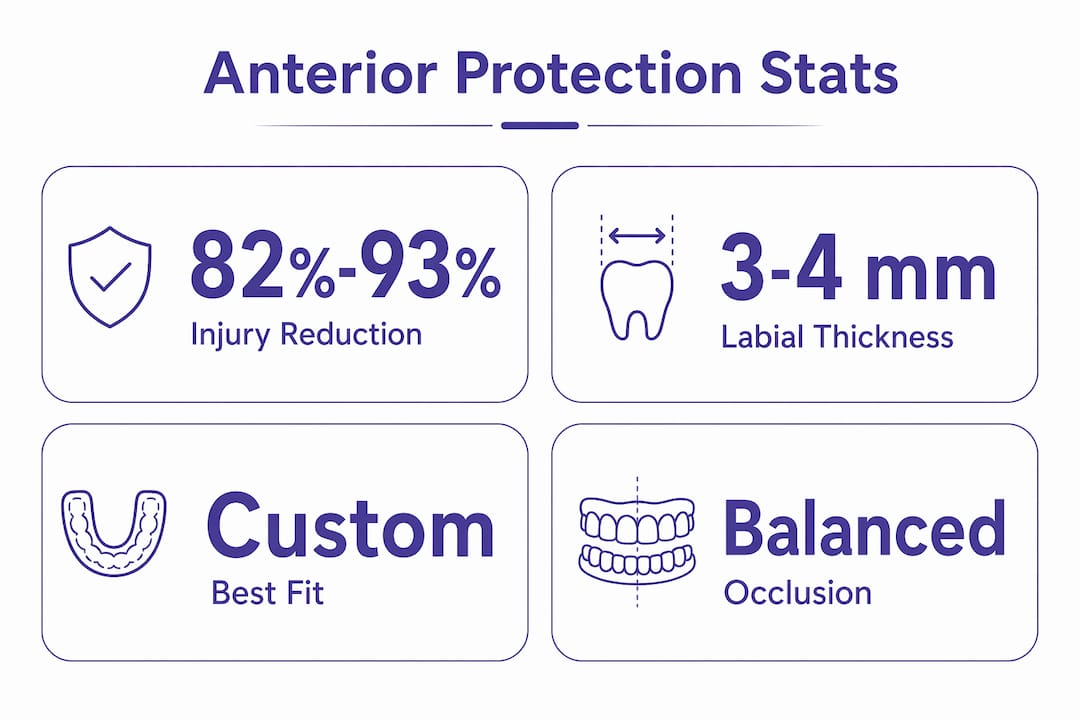
Anterior-tooth protection in a guard lowers the risk of front-tooth fractures and avulsion by distributing and slowing an impact force before it concentrates on the incisor root. Three design factors determine whether that protection actually works: labial thickness of 3–4 mm over the central incisors, secure fit and retention, and balanced occlusal contact with the lower anterior teeth. Get all three right and a guard can reduce the mechanical stress reaching the tooth root substantially. Miss any one of them and the guard may look protective without being protective.
- Labial thickness: Clinical studies recommend 3–4 mm over the central incisors; beyond 4 mm, additional thickness yields diminishing returns.
- Fit and retention: The American Dental Association stresses that an ill-fitting guard will not be worn consistently, which negates every other design advantage.
- Occlusal contact: When the guard contacts the lower anterior teeth, the mandible becomes part of the load-sharing structure, reducing guard displacement and spreading force across both arches.
A systematic review found that athletes wearing mouthguards are 82%–93% less likely to suffer traumatic dental injuries than those who go without. That figure alone makes the design details worth understanding.
Table of Contents
- What anterior-tooth protection in a guard actually means
- Why front teeth take the hardest hits
- How a mouthguard mechanically protects the front teeth
- Design features that protect your front teeth specifically
- Custom vs. boil-and-bite vs. stock: which type actually protects front teeth?
- What clinical studies and dental organizations actually recommend
- How to choose a guard and when to see a dentist
- How to care for a guard to keep anterior protection intact
- The labial thickness evidence in brief
- Key Takeaways
- Fit matters more than thickness alone
- Clearretain’s custom guards for anterior tooth protection
- Useful sources
What anterior-tooth protection in a guard actually means
“Anterior-tooth protection” refers to the guard’s ability to shield the six upper front teeth — the central incisors, lateral incisors, and canines — from direct impact, displacement, and soft-tissue injury. It involves three overlapping functions:
- Labial shielding: A layer of material sits between the lip and the tooth surface, absorbing and spreading force before it reaches enamel.
- Spacing and cushioning: A small gap or soft-layer zone in front of the incisors allows material deformation to extend impact duration, reducing peak load.
- Occlusal support: Contact with the lower arch prevents the guard from being driven back into the teeth and recruits the jaw muscles and mandible into force absorption.
Guard types address these functions differently:
- Custom-fitted guards (vacuum-formed or pressure-laminated) are fabricated on a dental model and deliver predictable labial thickness, controlled spacing, and bilateral occlusal balance.
- Boil-and-bite guards adapt to the arch shape at home but offer inconsistent labial thickness and often poor occlusal contact.
- Stock guards come in fixed sizes, require biting to hold in place, and provide the least reliable anterior coverage.
- Occlusal/anterior bite guards (night guards) are designed primarily for bruxism but share many of the same anterior-coverage principles.
Use-case mapping matters here. Sports guards prioritize impact absorption and labial thickness. Night guards for bruxism focus on distributing grinding forces and preventing enamel wear. Orthodontic patients need guards that accommodate brackets or wires without compromising anterior coverage. Pediatric guards require more frequent replacement as teeth erupt and the arch changes shape.
Why front teeth take the hardest hits
Upper central incisors are the most frequently injured teeth in sports and recreational accidents. Their position at the front of the arch means they intercept direct frontal impacts with almost no structural buffer. The crown is supported by a single root anchored in the alveolar bone through the periodontal ligament (PDL), a thin fibrous structure that handles compressive forces reasonably well but is far more vulnerable to tensile and shear stresses generated by horizontal blows.
Finite element simulations consistently show that incisor roots sustain peak mechanical stress during frontal impacts. Without a guard, that stress concentrates at the cervical third of the root, the zone most prone to fracture and luxation. Common anterior injuries include:
- Crown fractures (enamel-only, enamel-dentin, or involving the pulp)
- Root fractures at the cervical or mid-root level
- Luxation injuries (lateral, intrusive, or extrusive displacement)
- Avulsion (complete tooth displacement from the socket)
- Soft-tissue lacerations to the lips, gingiva, and frenum from tooth edges or appliances
The clinical reality is sobering. Prevention is far more effective than treatment because fractured or avulsed anterior teeth have limited natural recovery capacity. A replanted avulsed tooth has a guarded long-term prognosis; a well-designed guard prevents the injury entirely.
Proclined maxillary incisors — teeth that angle forward beyond the normal range — face significantly higher risk. Their labial surface protrudes further from the arch, making them harder to cover adequately with a standard guard and more exposed to glancing blows. Custom vestibular extension and increased labial coverage are often necessary to achieve equivalent protection for proclined teeth.
How a mouthguard mechanically protects the front teeth
A guard converts a point load into a distributed load. Without protection, an impact force hits one or two teeth directly; with a guard in place, that same force spreads across the full arch, the palate, and — when occlusal contact is present — the mandible as well.
Sports dentistry literature describes three protection modes:
| Protection Mode | Mechanism | Primary Benefit |
|---|---|---|
| Type I: Absorption | Material deforms and absorbs energy at the impact site | Reduces peak force at the labial surface |
| Type II: Maxillary dispersion | Force spreads laterally across the upper arch and palate | Prevents single-tooth overload |
| Type III: Intermaxillary dispersion | Occlusal contact transmits load to the lower arch and jaw | Reduces guard displacement; recruits mandibular support |
The timing of deceleration matters as much as the total force absorbed. A guard that extends impact duration by even a few milliseconds through material deformation reduces the peak stress the tooth root experiences. This is why material choice and geometry both count: a 3 mm guard with a 1 mm hard frontal insert and a small spacer can outperform a bulkier 4 mm single-layer guard in simulation because the layered geometry extends that deceleration window.
Antagonist tooth contact — the guard touching the lower anterior teeth — forms a temporary structural bridge during impact. This converts the mandible into an active load-sharing element, substantially reducing guard displacement and the stress transmitted to the upper incisor roots.
Design features that protect your front teeth specifically
The labial zone is where anterior-tooth protection lives or dies. Here is what the evidence says about each design variable:
Labial thickness. The clinical and simulation consensus sits at 3–4 mm over the central incisors. At least 3 mm is needed to significantly reduce deformation under horizontal impact; beyond 4 mm, the additional bulk adds discomfort without proportional protective gain.
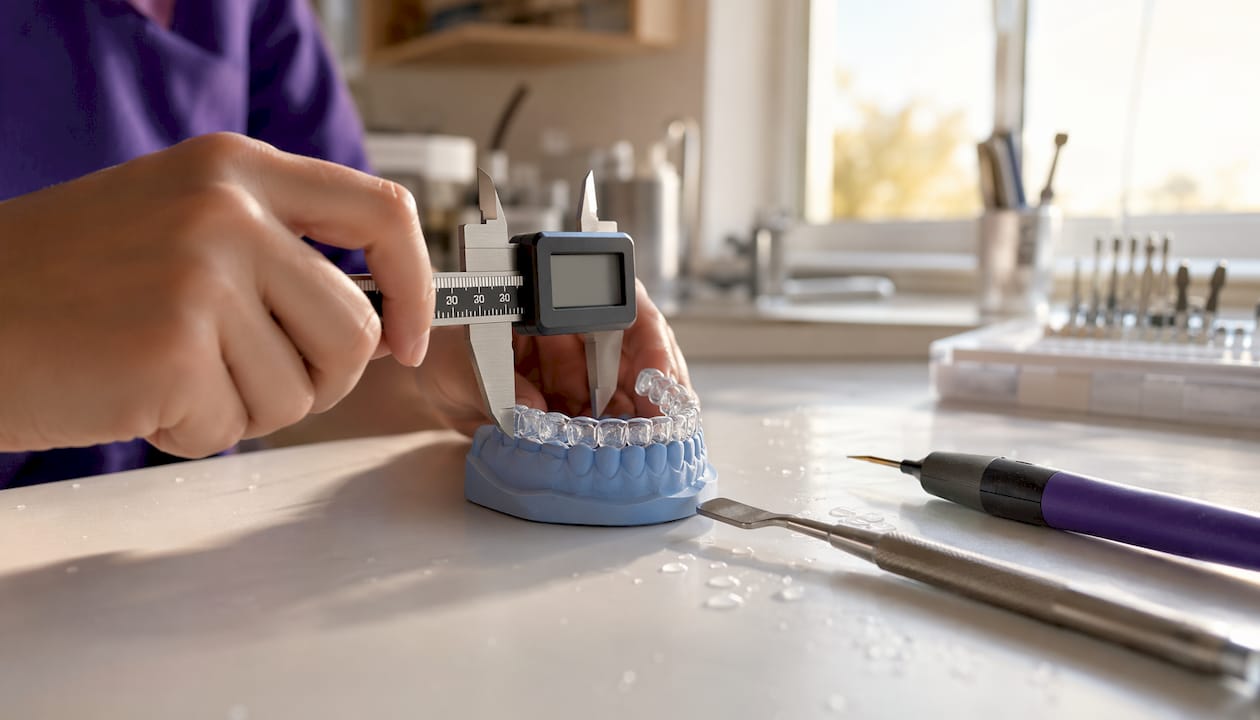
Spaced vs. full-contact fronts. A 1–2 mm gap between the guard’s inner surface and the labial face of the incisors allows the material to deform before contacting the tooth. FEA testing found lower stress concentrations in spaced designs compared to conventional full-contact guards under comparable loads. The trade-off is that the spacer must be sized correctly — too large and the guard loses retention.
Material layering. Single-layer EVA (ethylene-vinyl acetate) is the most common guard material. Multi-layer designs that combine a soft outer layer with a harder inner insert extend impact duration and recruit more teeth into load-sharing. A 3 mm guard with a hard frontal insert can match or exceed the protection of a thicker single-layer guard while being more comfortable to wear.
Vestibular extension. The guard should extend labially to within approximately 2 mm of the vestibular fold. This extension protects the soft tissues and helps the guard stay seated under impact.
Occlusal contacts. Bilateral, balanced occlusal contact prevents the guard from rocking or displacing during an impact. A guard that contacts only on one side or not at all will shift under load, concentrating force rather than distributing it.
- Labial thickness: 3–4 mm over central incisors
- Spacer option: 1–2 mm gap in modified designs for stress reduction
- Material: multi-layer EVA or hard-insert composite preferred over single-layer
- Vestibular extension: to within ~2 mm of the fold
- Occlusal contact: bilateral and balanced
Pro Tip: If a guard is uncomfortable enough that you take it out during play or sleep, it provides zero protection. Fit and comfort drive consistent use more than any single thickness specification.
Custom vs. boil-and-bite vs. stock: which type actually protects front teeth?
The short answer: custom guards win on every measurable criterion for anterior protection. The longer answer involves knowing when the difference matters most.
Custom-fitted guards are fabricated on a precise dental model, so labial thickness is controlled, occlusal contacts are balanced, and vestibular extension is tailored to the individual arch. Sports dentistry reviews consistently recommend custom vacuum-formed or pressure-laminated guards for high-risk users. They stay in place without biting pressure, which means breathing and speech are less affected.
Boil-and-bite guards adapt to the arch but cannot guarantee consistent labial thickness or balanced occlusal contacts. The softening process often results in thin spots directly over the central incisors — exactly where thickness matters most. For lower-risk recreational activities, they are a reasonable option; for contact sports or proclined incisors, the fit limitations are a real concern. A detailed custom vs. boil-and-bite comparison is worth reviewing before you decide.
Stock guards require constant biting pressure to stay in place. That alone disqualifies them for serious anterior protection: a guard that moves under normal use will not stay seated under impact.
- High-contact sports (football, hockey, martial arts): Custom only.
- Orthodontic appliances present: Custom, with accommodation for brackets/wires.
- Heavy bruxism: Custom night guard with controlled labial and occlusal coverage.
- Proclined incisors: Custom with extended vestibular coverage.
- Recreational low-contact activity, budget-limited: Boil-and-bite as a minimum; upgrade when possible.
What clinical studies and dental organizations actually recommend
The evidence base for anterior-tooth protection is substantial and consistent across study types.
The American Dental Association recommends that mouthguards extend at least to the distal aspect of the first molar and maintain a labial and occlusal thickness of 3 mm, with palatal thickness of 2 mm. Occlusion should be bilateral and balanced. The ADA also emphasizes that proper fit and retention are non-negotiable because a guard that is not worn provides no protection.
A prospective longitudinal study analyzing over 70,000 athlete exposures found that mouthguard users had traumatic dental injury rates of 0.6% versus 2.0% for non-users, and dental referral rates of 1.6% versus 5.8%. Before mandatory mouthguard use in American football, oral and facial trauma accounted for 50% of all reported injuries; after introduction of protective gear, that figure dropped to 3.9%.
Key evidence-based takeaways:
- 3–4 mm labial thickness is the clinically supported target for central incisor protection.
- Spaced designs with hard inserts reduce stress concentrations compared to standard single-layer guards.
- Custom guards provide superior fit, balanced occlusion, and consistent labial coverage.
- Retention and comfort determine real-world use; a guard worn inconsistently offers no protection.
- Athletes with proclined incisors need custom guards with extended labial coverage.
How to choose a guard and when to see a dentist
Buying checklist for front-tooth protection, in order of priority:
- Confirm labial thickness. Ask the manufacturer or provider for the labial thickness specification over the central incisors. Anything under 3 mm is insufficient for contact sports.
- Check for occlusal balancing. The guard should contact the lower arch bilaterally. Ask whether the design includes occlusal balancing or whether it is a single-arch guard with no lower contact.
- Ask about spacer options. For high-impact use, ask whether a modified design with a frontal spacer is available.
- Verify material. Multi-layer EVA or a hard-insert composite offers better anterior protection than single-layer stock material. FDA-approved materials are the baseline standard.
- Test retention at home. A properly fitted guard should stay in place without biting pressure. Open your mouth slightly — if the guard drops, the fit is inadequate.
- Check speech and breathing. Some interference is normal initially, but significant difficulty suggests the guard is too bulky or poorly fitted.
- Assess vestibular extension. The guard should extend close to the vestibular fold without causing discomfort. Insufficient extension leaves soft tissue unprotected.
See a dentist before ordering or wearing a guard if:
- Your incisors are proclined or significantly crowded.
- You have had recent dental trauma (fracture, luxation, or avulsion).
- You are currently in orthodontic treatment with brackets or wires.
- Your guard displaces frequently during use.
- You have visible wear, cracks, or thinning in the front zone of your current guard.
For pediatric patients, children’s night guard fitting requires more frequent reassessment as the arch develops. A guard that fit well six months ago may no longer cover the anterior zone adequately after tooth eruption. If you notice signs of dental abrasion or worn enamel, a dental professional evaluation can assess whether the guard is still providing adequate coverage.
How to care for a guard to keep anterior protection intact
A guard that has thinned, cracked, or lost its shape in the front zone no longer provides the labial thickness it was designed to deliver. Maintenance is not optional.
Daily cleaning:
- Rinse with cool water immediately after use (hot water warps EVA material).
- Brush gently with a soft toothbrush and mild soap — not toothpaste, which is abrasive enough to thin the labial surface over time.
- Allow to air-dry completely before storing in a ventilated case.
Weekly inspection:
- Hold the guard up to light and check the labial zone for thinning, discoloration, or cracks.
- Press the front zone gently between your fingers. If it compresses noticeably or feels uneven, the material has degraded.
- Check that the vestibular extension is intact and has not torn or pulled back.
Replacement triggers:
- Visible cracks or tears anywhere in the guard.
- Thinning in the labial zone (the guard feels noticeably thinner than when new).
- Loss of retention — the guard no longer seats firmly without biting pressure.
- Any impact event that caused the guard to deform visibly.
- For athletes: reassess at the start of each season. For heavy bruxers: inspect every three months, as grinding accelerates material compression.
The labial thickness evidence in brief
The numeric specification that matters most for anterior protection is 3–4 mm of labial thickness over the central incisors. Here is what the research behind that number actually shows:
3–4 mm labial thickness is the clinically supported range for optimal impact force reduction over the central incisors. Thickness below 3 mm fails to significantly reduce deformation under horizontal impact. Thickness above 4 mm adds bulk without proportional protective benefit.
Supporting findings:
- At least 3 mm thickness is needed to significantly reduce deformation under horizontal impact forces, which are the dominant injury mechanism for anterior teeth.
- A 1–2 mm spacer in front of the maxillary incisors, combined with a hard frontal insert, reduces stress concentrations compared to conventional full-contact designs.
- Optimized geometry (hard insert plus soft backing plus small spacer) allows a 3 mm guard to match or exceed the protection of bulkier single-layer guards in simulation and lab impact tests.
For readers who want the full study details, the three most directly relevant sources are the Frontiers in Medicine 2025 thickness review, the Zenodo FEA evaluation of modified mouthguard designs, and the Sports Medicine Open 2024 paper on optimized mouthguard geometry. All three are linked in the sources section below.
Key Takeaways
Anterior-tooth protection in a guard depends on three measurable design factors: 3–4 mm labial thickness, secure retention, and balanced occlusal contact with the lower arch.
| Point | Details |
|---|---|
| Labial thickness target | 3–4 mm over central incisors; below 3 mm is insufficient, above 4 mm adds bulk without proportional benefit. |
| Fit and retention | A guard that displaces during use or is uncomfortable enough to remove provides no anterior protection. |
| Occlusal contact | Bilateral contact with the lower arch recruits the mandible into force distribution and reduces guard displacement. |
| Custom vs. alternatives | Custom-fitted guards deliver predictable labial thickness and occlusal balance; boil-and-bite guards often thin out over the central incisors. |
| Clearretain option | Clearretain’s Upper Retainer-Night Guard, Lower Retainer-Night Guard, and Upper and Lower set are custom-fitted with FDA-approved materials and controlled anterior coverage. |
Fit matters more than thickness alone
The research on anterior-tooth protection is clear about one thing that often gets lost in the conversation about millimeters and materials: a guard that stays in place and feels comfortable will be worn. One that does not will sit in a bag. That gap between laboratory performance and real-world use is where most protection failures actually happen.
Thickness specifications and material science matter, but they are only relevant when the guard is in the mouth. Proclined incisors, orthodontic appliances, and recent dental trauma all change the fitting equation in ways that a standard off-the-shelf product cannot accommodate. For those cases, professional fitting is not a luxury — it is the only way to get the labial coverage and occlusal balance the evidence calls for.
The practical priority order: get the fit right first, confirm the labial thickness second, and then consider material upgrades. A 3 mm custom guard worn consistently outperforms a 4 mm guard that gets taken out at halftime.
Clearretain’s custom guards for anterior tooth protection
Custom-fitted guards that actually meet the 3–4 mm labial thickness standard and deliver balanced occlusal contact are harder to find than the marketing suggests. Clearretain builds its night guards and retainer-guards to those specifications using FDA-approved materials, fabricated under the supervision of experienced orthodontic technicians.
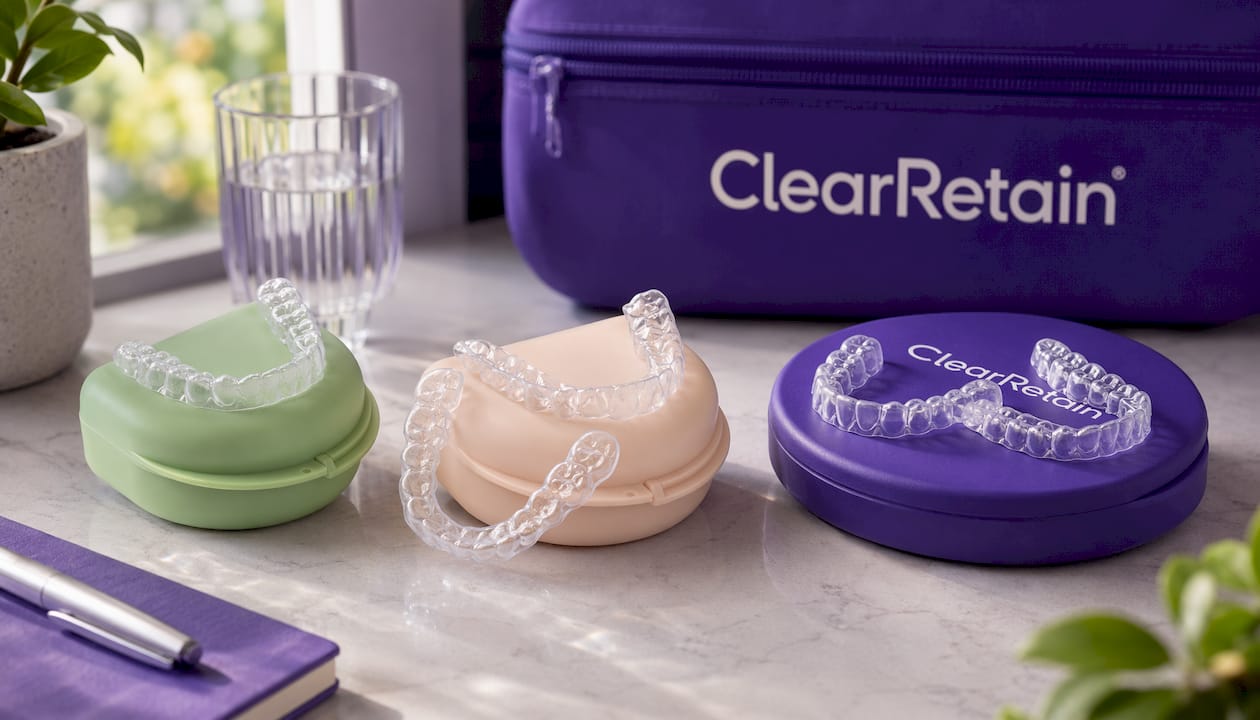
Three configurations address different anterior-protection needs. The Upper Retainer-Night Guard covers the maxillary arch with controlled labial thickness and vestibular extension — the right choice for athletes and bruxism patients who need upper anterior coverage. The Lower Retainer-Night Guard targets heavy grinders who need occlusal support from the lower arch. For full intermaxillary force distribution, the Upper and Lower set provides bilateral contact and the mandibular support the biomechanics research points to as the most complete protection model.
Ordering uses a self-impression kit with detailed instructions — no office visit required. Stored digital impressions make reorders fast. For complex cases (proclined incisors, active orthodontic treatment, recent trauma), consult a dentist before ordering so the guard design can be adjusted to your specific anatomy.
Useful sources
-
Sport and Dental Traumatology: Surgical Solutions and Prevention — PMC peer-reviewed article covering injury statistics, mouthguard effectiveness data (82%–93% injury reduction), and the four core protective functions of mouthguards. The primary source for injury prevalence figures cited in this article.
-
Frontiers in Medicine (2025): Mouthguard Thickness Recommendations — The most current clinical review of labial thickness evidence, supporting the 3–4 mm recommendation and the diminishing-returns finding above 4 mm.
-
Frontiers in Dental Medicine (2024): Development Status of Mouthguards — Covers the three protection modes (Type I/II/III) and the horizontal-impact significance of labial thickness.
-
Sports Medicine Open (2024): Optimized Mouthguard Geometry — Impact test and simulation data showing how a hard frontal insert with a spacer allows a 3 mm guard to match thicker single-layer designs.
-
Zenodo FEA Evaluation of Modified Mouthguards — Finite element analysis comparing spaced and full-contact designs; source for the stress-concentration reduction finding.
-
Wiley: Antagonist Tooth Contact and Mouthguard Biomechanics — Documents how lower anterior contact reduces guard displacement and distributes force across both arches.
-
American Dental Association: Athletic Mouth Protectors — ADA guidance on fit, retention, thickness standards, and compliance. The authoritative U.S. clinical reference for mouthguard specifications.
-
PMC: Sports Dentistry and Prevention Perspective — Clinical review emphasizing force distribution across the arch and the limited recovery potential of fractured or avulsed anterior teeth.
-
Clearretain: Contact Sport Mouth Guard Benefits — Sport-specific guidance on mouthguard design standards and retention for athletes.
-
Clearretain: Custom vs. Boil-and-Bite Mouth Guards — Detailed comparison of guard types and the trade-offs relevant to anterior protection.
-
Towne Dental: General Dentistry for All Ages — For readers who need professional custom fitting, trauma assessment, or orthodontic conflict evaluation.
This article is general educational information, not professional dental advice. Confirm current clinical guidelines and your specific situation with a licensed dentist or dental specialist.