



Whitening HSA Eligible: What U.S. Account Holders Need to Know
No. Routine teeth whitening is not HSA-eligible. The IRS explicitly lists teeth whitening as a cosmetic procedure that does not qualify as a medical expense under Publication 502, and that rule applies whether you buy strips at the drugstore, get custom trays from your dentist, or sit in a chair for professional bleaching.
The IRS test is about intent, not location or price. An expense qualifies only if its primary purpose is to prevent or treat disease, not to improve how your smile looks. Whitening almost always fails that test because it’s cosmetic by definition, regardless of who performs it.
Here’s what to do depending on where you are in the process:
- Already paid with your HSA debit card? Keep your receipt, flag the transaction in your own records, and be ready to report it as a non-qualified distribution on Form 8889 if you can’t tie it to a documented medical condition.
- Still deciding how to pay? Use a personal card or cash for whitening, and save your HSA funds for expenses that clearly meet the IRS medical expense standard.
If your situation involves discoloration from an injury, illness, or medication rather than ordinary yellowing, keep reading. There’s a narrow but real path to eligibility, and it starts with documentation from a licensed provider, not a receipt from a drugstore.
Key Takeaways
Teeth whitening fails the IRS medical necessity test in nearly every scenario, and only a documented medical condition tied to a Letter of Medical Necessity can change that outcome.
| Point | Details |
|---|---|
| Direct answer | Routine whitening, whether OTC strips, custom trays, or in-office bleaching, is not HSA-eligible under IRS Publication 502. |
| The IRS test | Eligibility depends on treating disease or structural defect, not on who performs the procedure or where. |
| Narrow exceptions exist | Discoloration from trauma, disease, or medication can qualify with a proper Letter of Medical Necessity. |
| Documentation is everything | Keep itemized invoices, provider letters, and EOBs before submitting any borderline claim. |
| Misuse has tax consequences | Non-qualified HSA spending under age 65 triggers income tax plus a 20% penalty, reported on Form 8889. |
| Out-of-pocket alternative | Clearretain’s whitening serum and bleaching trays offer a lower-cost route when HSA funds don’t apply. |
Consult a tax advisor for any case involving combined restorative and cosmetic work, since those situations rarely have a clean yes or no answer.
Table of Contents
- Why whitening usually isn’t HSA-eligible: the IRS cosmetic test
- Is teeth whitening HSA eligible in common real-world situations?
- When can whitening-related costs become HSA-eligible?
- How do you document and submit a whitening-related HSA claim?
- What happens if you use HSA funds for ineligible whitening?
- What dental expenses are HSA-eligible instead of whitening?
- What should you do if you’re still not sure?
- Treat your HSA dollars like they’re being watched, because they are
- If you’re paying out of pocket, here’s what actually makes sense
- Where to verify this information yourself
- Frequently Asked Questions
- Sources
Why whitening usually isn’t HSA-eligible: the IRS cosmetic test
The IRS draws a hard line between medical care and cosmetic enhancement. Publication 502 defines qualified medical expenses as costs for the diagnosis, cure, mitigation, treatment, or prevention of disease, or for affecting any structure or function of the body. Whitening doesn’t touch any of that. It changes the color of enamel. It doesn’t treat decay, disease, or structural damage.
Cosmetic procedures are generally not deductible, and the IRS specifically names teeth whitening as an example of a cosmetic expense that isn’t includible, even when a dentist performs it.
That single line does more work than any other sentence in the tax code on this topic. It closes the door on the common argument that “a dentist did it, so it must be medical.” The IRS doesn’t care who performed the procedure. It cares why.
Here’s how the split typically shakes out in practice:
- Usually cosmetic (not eligible): teeth whitening, veneers placed purely for appearance, teeth bonding done only to change tooth color.
- Usually medical (eligible): fillings, root canals, extractions, periodontal treatment, and orthodontia when a dentist documents a functional or structural problem.
- Gray area (depends on documentation): crowns and restorations that happen to look better but were placed to fix a broken or decayed tooth.
Healthcare frames HSAs the same way: they’re built to cover IRS-qualified medical expenses tied to a high-deductible health plan, not general wellness or appearance spending. That framing matters because it shows the whitening exclusion isn’t a quirk of dental rules specifically. It’s the same principle that keeps gym memberships and cosmetic surgery off the eligible list too.
Is teeth whitening HSA eligible in common real-world situations?
Most people don’t ask this question in the abstract. They ask it holding a receipt or staring at a treatment estimate. Here’s how the usual scenarios play out.
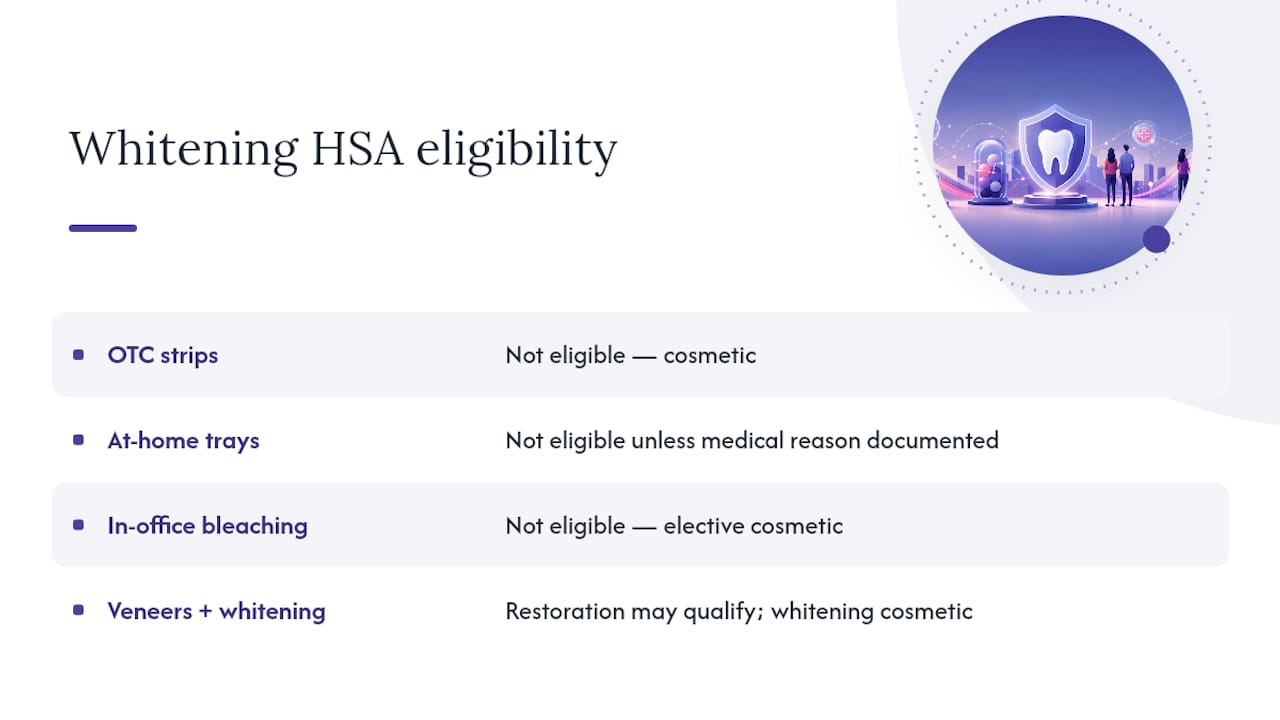
Over-the-counter strips and whitening gels. These are the clearest no. Crest Whitestrips, drugstore trays, whitening toothpaste, and similar products are general-use cosmetic items. MetLife’s guidance points out that generic dental products not tied to treating a diagnosed condition don’t qualify, no matter how the packaging markets them.
At-home custom trays, store-bought or dentist-made. The delivery method doesn’t change the answer. A dentist-fabricated tray filled with professional-strength gel is still whitening. Unless a licensed provider documents a specific medical reason for the treatment, the custom fit doesn’t convert a cosmetic purchase into a medical one.
In-office professional bleaching. Sitting in a dental chair for a Zoom or laser whitening session feels more clinical than swiping on a drugstore strip, but the IRS doesn’t grade on setting. Humana’s guidance confirms that elective cosmetic dental procedures, whitening included, typically stay outside HSA eligibility even when performed by a licensed dentist.
Veneers and whitening done together. This one gets tangled fast. If you need a crown or restoration for a genuinely damaged tooth, that restorative work can be eligible. But whitening performed afterward to match the new work to the rest of your smile is usually treated as separate and cosmetic, unless your provider documents the shade matching as part of the medical treatment plan itself. Some providers view it the other way too: whitening done first to establish a baseline shade before a medically necessary restoration may be eligible if your dentist ties it directly to that treatment in writing.
When can whitening-related costs become HSA-eligible?
The exceptions are real, but they’re narrow, and they hinge entirely on documentation, not on how you personally feel about your teeth.
A handful of situations can justify medical necessity:
- Discoloration from dental trauma. A tooth that died and darkened after an injury may qualify if whitening or internal bleaching is part of treating that specific tooth.
- Discoloration linked to disease or its treatment. Certain illnesses and long-term medication use (tetracycline staining is the classic example) can cause discoloration that a dentist ties directly to a medical cause.
- Whitening required to complete a documented restorative plan. When shade matching is written into the treatment plan for a medically necessary crown or bonding procedure, some providers and administrators will consider it part of that treatment.
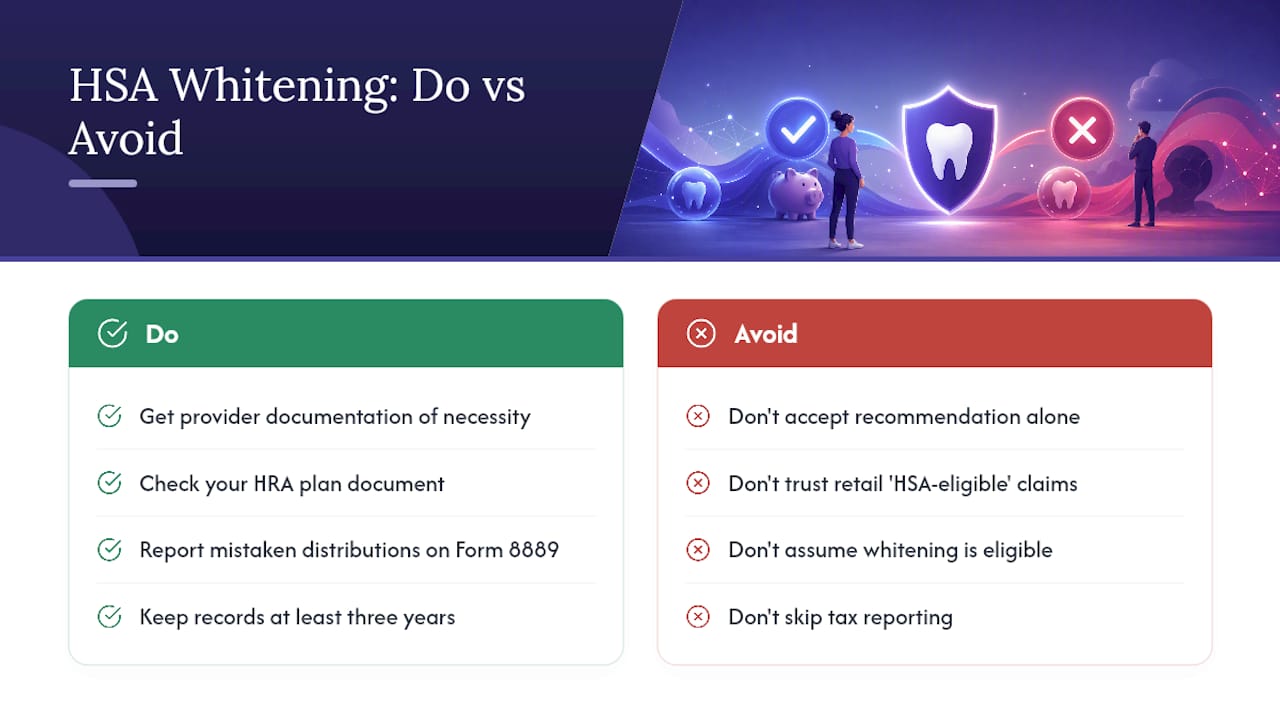
Outside of these, the IRS view stays strict: cosmetic intent disqualifies the expense regardless of what your dentist recommends. A recommendation isn’t the same as a medical diagnosis tied to disease or structural repair.
If your situation fits one of the exceptions, here’s what to collect before you touch your HSA card:
- A written diagnosis from your dentist or physician naming the specific condition.
- A treatment plan that explicitly connects the whitening procedure to that diagnosis.
- A dated statement explaining why whitening is part of treating the condition, not just improving appearance.
A Letter of Medical Necessity (LMN) is the document that ties all of this together. Plan administrators generally want it to include the patient’s diagnosis, a clear statement that the treatment addresses that diagnosis, the recommended treatment (including whitening specifically), the expected duration, and the provider’s signature and license information. A vague note that says “patient would benefit from whitening” won’t pass muster. The letter needs to name the disease or defect and connect it directly to the recommended treatment.
Pro Tip: Before you spend a dollar, call your HSA custodian and ask for written pre-approval or at least written confirmation that your documentation would satisfy their eligibility review. A five-minute phone call can save you from an unwanted tax bill later.
Financial and tax professionals consistently note that the IRS assesses eligibility by the primary purpose of a procedure. Provider recommendation alone rarely overrides a cosmetic classification.
How do you document and submit a whitening-related HSA claim?
If you believe your situation qualifies, the submission process follows a predictable sequence. Skipping a step is usually what triggers a denial or, worse, an unflagged mistake that surfaces later during an audit.
- Collect your itemized invoice. It needs to show the specific procedure, the date, the cost, and the provider’s name. A generic receipt that just says “dental services” won’t hold up.
- Get your Letter of Medical Necessity. This comes from the dentist or physician who diagnosed the underlying condition, not a general dentist who simply performed the whitening.
- Request an Explanation of Benefits (EOB) from your dental insurer if the procedure was billed through insurance at all, even partially.
- Submit the full packet to your HSA custodian through their claims or reimbursement portal, along with proof of payment.
Keep these documents together in one place, physical or digital, because you’ll want quick access to all of them:
- Itemized invoice with procedure codes and dates.
- Signed Letter of Medical Necessity.
- Explanation of Benefits, if applicable.
- Proof of payment (bank or card statement showing the transaction).
If your claim gets denied, don’t treat that as the final word. Ask your plan administrator specifically what was missing. Sometimes it’s as simple as the LMN not naming the diagnosis clearly enough. You can typically resubmit with a revised letter or request a formal reconsideration, and administrators are usually more flexible on appeal than on the first pass, especially when your documentation improves.
What happens if you use HSA funds for ineligible whitening?
Using your HSA debit card for a cosmetic whitening treatment doesn’t trigger an instant penalty at checkout. The card doesn’t know the difference. The problem shows up later, and it’s worth understanding before you swipe.
If you use HSA money for a non-qualified expense and you’re under 65, the IRS treats that amount as a taxable distribution and adds a 20% penalty on top of regular income tax. If you’re 65 or older, the penalty disappears, but the distribution still counts as taxable income. Either way, it needs to be reported.
The IRS requires you to report HSA distributions on Form 8889 each year, and any amount spent on a non-qualified expense like cosmetic whitening becomes part of your taxable income for that year.
Every HSA card transaction leaves a paper trail with your custodian, and that trail is exactly what an IRS audit would pull if your account gets flagged for review. Whitening purchases at a dental office are easy to spot because the merchant category often reveals the type of provider, even when the description is vague. Keeping your own documentation is your best defense if that ever happens.
If you’ve already made this mistake, you have a few realistic options. You can return the funds to your HSA before the tax filing deadline in some cases, though this depends on your custodian’s policies and timing. You can report the distribution honestly on Form 8889 and pay the tax and penalty due. Or, if your situation is genuinely ambiguous, like a partial restoration mixed with whitening, it’s worth a conversation with a tax advisor before you file anything.
What dental expenses are HSA-eligible instead of whitening?
If whitening is off the table, your HSA still covers plenty of dental care, some of which improves your smile’s appearance as a byproduct of treating an actual problem.
- Routine cleanings and X-rays are eligible and considered preventive care.
- Fillings, root canals, and extractions qualify because they treat active disease or decay.
- Crowns, when placed to repair a damaged or decayed tooth rather than purely for cosmetic reasons, are generally eligible.
- Medically necessary orthodontia, when a dentist or orthodontist documents a functional need like a bite correction, can be HSA-eligible according to Humana.
- Night guards for diagnosed bruxism qualify when a dentist documents the grinding condition, a detail worth understanding if you’ve wondered how insurance treats night guard coverage.
Restorative work sits in an interesting middle ground. A crown placed on a cracked molar will naturally look better than the damaged tooth it replaced, and that’s fine. The eligibility comes from treating the crack, not from the cosmetic upside. The same logic applies to orthodontia: braces that correct a genuine bite problem happen to straighten your smile too, but the medical justification is what gets it covered, not the appearance change.
For a broader look at where your money stretches further outside HSA reimbursement, affordable dental care alternatives are worth reviewing alongside your plan’s preventive benefits.
What should you do if you’re still not sure?
Uncertainty is normal here, especially in the gray-area cases involving trauma, medication side effects, or combined restorative and cosmetic work. A short checklist beats guessing.
- Identify the primary intent of the treatment. Is it treating a diagnosed condition, or is it about appearance? Be honest with yourself here, because the IRS will be.
- Gather documentation before you pay, not after. Retroactive letters of medical necessity are harder to obtain and less convincing to plan administrators.
- Ask your provider directly for an LMN if you believe your case qualifies, and ask them to name the specific diagnosis in writing.
- Get written confirmation from your HSA custodian before spending, especially for anything over a few hundred dollars.
When you reach out, know exactly what to ask:
- Your dentist or physician: “Can you provide a Letter of Medical Necessity that names my diagnosis and ties this treatment to it?”
- Your HSA custodian or plan administrator: “Based on this documentation, would this expense be considered eligible under our plan?”
- A tax advisor: “Given my specific situation, how should I report this if the eligibility is unclear?”
Keep your records for at least three years after filing, which lines up with the standard IRS statute of limitations for audits, though some tax professionals recommend seven years for HSA documentation specifically given how these accounts get scrutinized. Partner guidance on HSA documentation covers similar recordkeeping habits worth adopting across any HSA-eligible purchase, not just dental care.
Treat your HSA dollars like they’re being watched, because they are
Here’s the practical stance worth taking: assume every HSA dollar you spend could get a second look, and document accordingly, even for expenses that feel obviously fine. That mindset costs you nothing and protects you completely.
In my experience reviewing how plan administrators actually handle these cases, the ones who get burned aren’t the people trying to game the system. They’re the people who assumed a dentist’s recommendation was enough proof on its own. It never is. The provider’s letter needs to name a diagnosis, not just a suggestion. That distinction determines whether your documentation holds up or falls apart under review.
If you remember two things from everything above, make it these: Publication 502 is the rulebook, and a proper Letter of Medical Necessity is your only real lever for turning a gray-area expense into a defensible one. Everything else, the receipts, the EOBs, the phone calls to your custodian, exists to support those two anchors.
If you’re paying out of pocket, here’s what actually makes sense
Since whitening almost always comes out of your own pocket rather than your HSA, the real question becomes where to spend that money wisely. Dental offices routinely charge premium markups for both whitening treatments and the plastic trays and retainers that go with them.
Clearretain sells the same category of products, custom-fit trays, whitening serum, and retainers, made under the supervision of experienced orthodontic technicians, at prices that run up to 80% below traditional in-office costs. If you want whitening without the office visit markup, the tooth whitening serum is designed to work with a clear retainer or night guard you may already own, and the teeth bleaching trays give you a custom fit through a self-impression kit you complete at home rather than in a dental chair. If you also need a retainer for orthodontic retention, the upper and lower retainer set covers both arches in one order.
Whatever you buy, keep your invoice and any provider correspondence in the same file where you store your other dental records. Even non-HSA purchases are worth documenting, both for your own budgeting and in case a future medical circumstance changes how that expense should be classified. Ready to compare options? Start with Clearretain’s full retainer lineup and see what fits your situation.
Where to verify this information yourself
The rules on HSA eligibility come from a small number of authoritative sources, and it’s worth bookmarking them rather than relying on secondhand summaries.
- IRS Tax Topic 502 lays out the general rule for medical and dental expense deductions and eligibility.
- IRS Publication 502 explicitly names teeth whitening under expenses you can’t include, and it’s the single most important document for this topic.
- Healthcare explains the HDHP requirement and the general purpose of HSA funds.
- Humana’s dental HSA/FSA guidance shows real-world examples of when orthodontic and restorative work counts as medically necessary.
- Northwestern Mutual’s HSA coverage guide offers a financial planning perspective on which expenses insurers and advisors flag as cosmetic versus medical.
Frequently Asked Questions
Is teeth whitening HSA eligible if my dentist recommends it?
No. A dentist’s recommendation alone doesn’t establish medical necessity. The IRS requires the primary purpose to be treating disease or a structural defect, and a recommendation for whitening is almost always about appearance, not treatment.
Is whitening FSA eligible the same way it’s HSA eligible?
Yes. FSAs and HSAs follow the same IRS definition of qualified medical expenses, so teeth whitening is excluded from both under Publication 502. An HRA, since it’s typically employer-defined, may have different terms, so check your specific plan document.
Are HSA-approved whitening solutions available anywhere?
Not in the general sense. No mainstream whitening product carries blanket HSA approval, because eligibility depends on individual medical documentation, not the product itself. A whitening kit sold as HSA-eligible on a retail site should be treated with skepticism unless it comes with clear IRS-backed justification.
Can I use HSA funds for whitening if I also need a crown or veneer?
The restorative work itself may be eligible if it treats a damaged or decayed tooth. The whitening portion typically stays ineligible unless your provider documents shade matching as part of that specific medical treatment plan.
What if I already used my HSA card for whitening by mistake?
Report the distribution on Form 8889 and expect it to count as taxable income, plus a 20% penalty if you’re under 65. Some custodians allow you to return the funds before the tax filing deadline, so contact them directly to ask about your options.
How long should I keep records for a whitening-related HSA claim?
Keep documentation for at least three years, matching the standard IRS audit window, though many tax professionals suggest holding HSA records for up to seven years given how closely these accounts get reviewed.
This article is general information, not a substitute for advice from a qualified financial advisor. Consult a qualified financial professional about your own circumstances before acting on anything here.
Sources
- IRS Tax Topic - Topic No. 502 Medical and Dental Expenses
- Publication 502 (2025), Medical and Dental Expenses | Internal Revenue Service
- Can I Use FSA or HSA to Pay for Dental Expenses? | Humana
- Healthcare